Cannabis, Depression, and the Topology of Your Brain
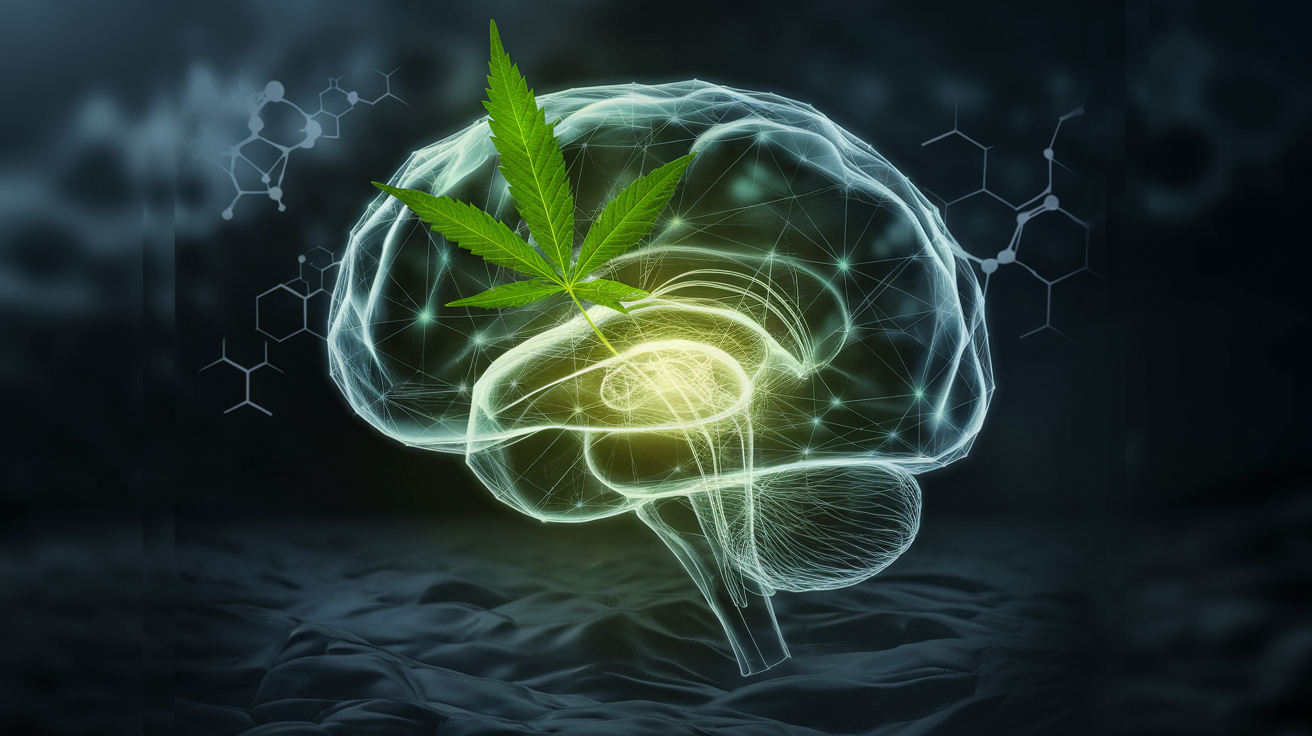
New research maps how cannabis use and depression interact to reshape the actual architecture of your brain's communication network. Depression isn't a chemical deficiency — it's a topological collapse. And the ECS is evolution's network administrator.

Full Article
Editor's Note: Research Commentary
This article discusses peer-reviewed research through the lens of far-from-equilibrium thermodynamics and the endocannabinoid system framework developed by Dr. Robert Melamede. All studies cited are real, published papers with PubMed links. The interpretive framework connecting them is the author's perspective. This is not medical advice.
Monday morning. Running shoes on. Made it to the front door. Checked PubMed. That was two hours ago. Still at my desk in running shoes that have not encountered pavement.
One paper. Liu et al. Drug and Alcohol Dependence. PubMed 41691822. Title: "The intersectionality of cannabis use and depression symptoms on functional brain topology in adults."
TOPOLOGY.
Not receptor binding. Not serotonin levels. The SHAPE. The architecture. The network organization of the depressed brain.
Let me tell you why this matters so much I forgot to go running.
Here is what mainstream psychiatry does with depression: treats it like a chemistry problem. Serotonin low. Add serotonin. A third of patients do not respond to the first antidepressant. The established protocol: try the next drug. And the next. Augment with a second agent. Maybe a third. ECT if nothing works.
Always more complexity. Never a different FRAME.
Bob Melamede had a phrase for this: adding floors to a cracked foundation. Build the whole pharmacological architecture on the wrong model of what depression IS, and you can stack drugs forever while the foundation stays cracked.
We built that architecture before we understood what the endocannabinoid system was doing. That was the 1980s. We are in 2026 and we are still building on the same foundation. Liu's paper is the crack showing.
A depressed brain, in Bob's thermodynamic framework, is a brain that has gotten closer to equilibrium. Not metaphorically. Literally. Less dynamic. Less far-from-equilibrium. The same patterns loop. The same circuits fire. 3 AM thoughts with nowhere to go. Network lost its flexibility.
The endocannabinoid system is the feedback mechanism the network uses to keep reorganizing itself. Retrograde signaling — postsynaptic neuron talking BACK to the presynaptic one. The network regulating its own activity. The ECS is literally the brain's self-organization machinery.
When you activate the ECS in a brain that has lost topological flexibility, you are not adding a chemical to a chemistry problem. You are introducing a REORGANIZATION SIGNAL to a network that has stopped reorganizing itself.
Different target. Different expected outcome. Different clinical implications.
What Liu found: depressed cannabis users have measurably different brain network topology than depressed non-users. The networks are organized differently. Some dimensions show more flexibility, not less. The ECS is in there doing something.
The question I keep wanting clinical psychiatry to ask — and cannot get asked because the field has four hours of ECS training in medical school — is this: which depressed patients are stuck because of network topology problems, and which are stuck because of chemical deficiency? Because those require different interventions. And the patient population that benefits from an ECS-mediated reorganization approach might be completely different from the one that responds to SSRIs.
We can't route patients to the right intervention if we're not asking the right question. And we're not asking the right question because we built the entire treatment paradigm before we understood the ECS.
Fifteen years building cannabis infrastructure in the United States. Arguing with regulators, investors, doctors. The serotonin model is a prison built in the 1980s. Liu is drawing you a map of the door.
Eventually went for the run. Late afternoon. Valencia waterfront. Came back. Read the paper one more time.
Same conclusion. Shoes got used. Paper still stands.
Flow forward.
Comments
Related Articles
Memory, Bones, and the Swedish Question: Your ECS Is Running the Show
The Most Important System You've Never Heard Of
The Physics Nobody Taught You
Stress Is Killing You — Literally
The Only Law That Matters
Want More?
Subscribe to The Forward Look on YouTube to get notified when new episodes drop.
Subscribe