A new meta-analysis claims cannabis causes oxidative stress. A Chinese team maps the cholecystokinin neuron network. Dr. Bob Melamede would have had things to say about both — and none of it was flattering to the people running these studies.
This article discusses peer-reviewed research through the lens of far-from-equilibrium thermodynamics and the endocannabinoid system framework developed by Dr. Robert Melamede. All studies cited are real, published papers with PubMed links. The interpretive framework connecting them is the author's perspective. This is not medical advice.
I am reading this digest at 8:15 on a Monday morning. Two papers. That is it. Two. Usually Mondays have more. These are thin.
Fine. Let's go.
Paper one: Zhang Z et al. Cholecystokinin neurons. Review article in Prog Neuropsychopharmacol Biol Psychiatry — which, yes, is a real journal with a real name that just happens to sound like it was generated by a Scrabble tournament. CCK. Cholecystokinin. You probably know it as the gut hormone. Satiety. Makes you stop eating. Textbook mentions it once. Never again.
That is insane.
Because CCK-expressing interneurons are not just in your gut. They're in your hippocampus. Amygdala. Prefrontal cortex. And they are inhibitory cells — meaning their entire function is to put the brakes on circuit activity. Memory consolidation. Fear. Pain. Working memory. CCK cells are part of the machinery that gates all of it.
Here's the part that matters for this site.
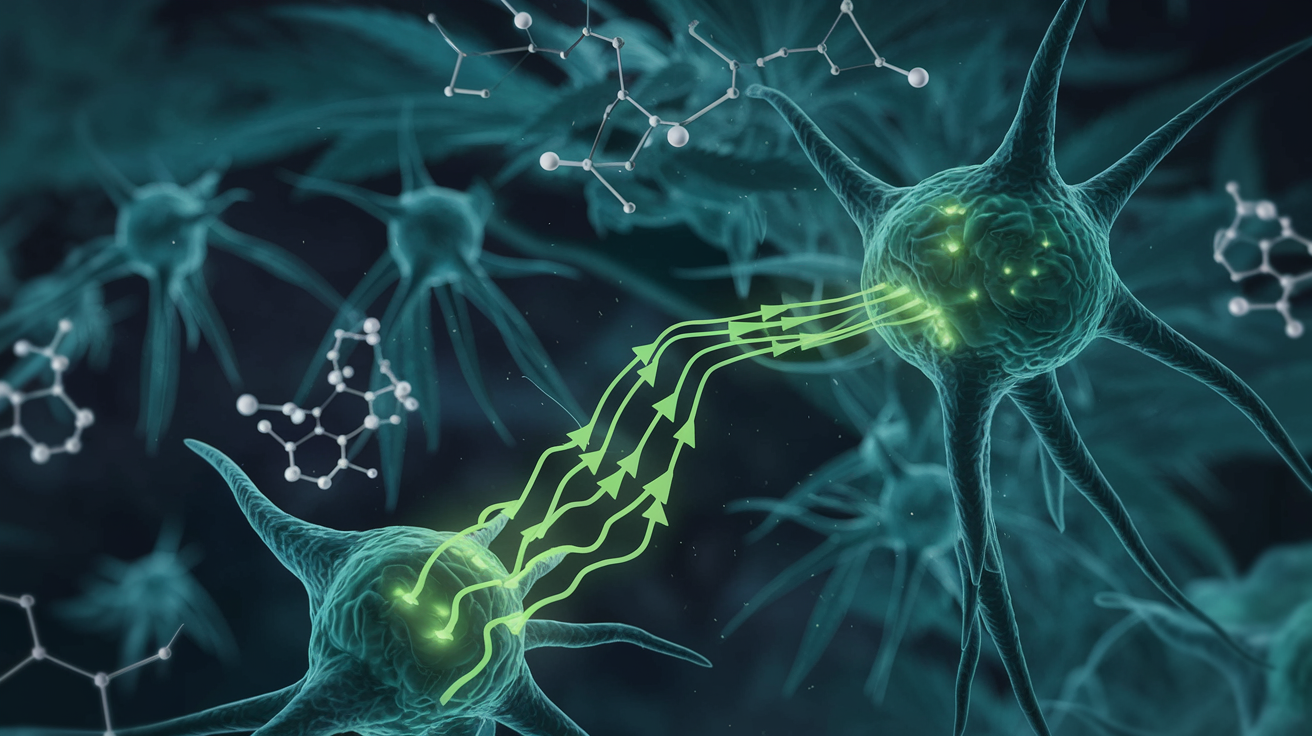
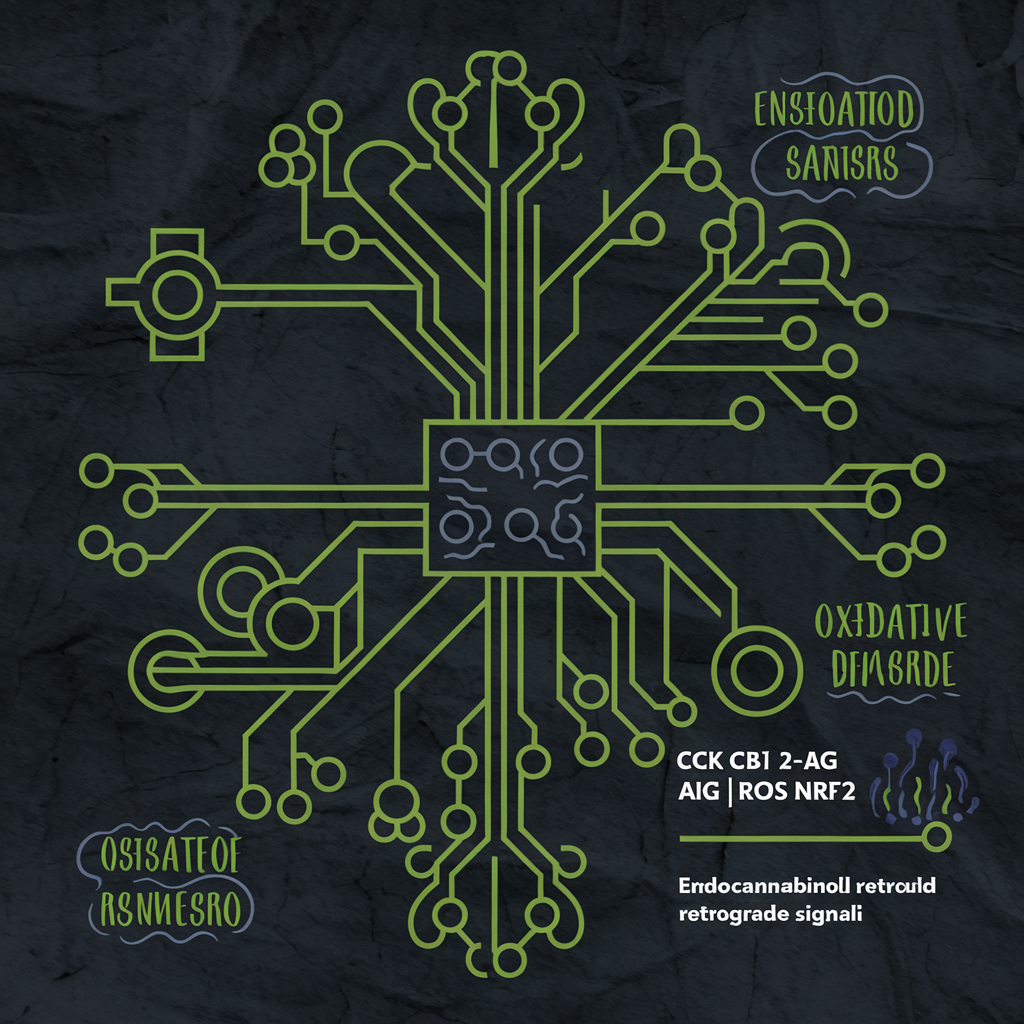
CCK interneurons in the hippocampus are primary targets for RETROGRADE endocannabinoid signaling. Postsynaptic neuron fires. Needs to throttle incoming excitatory drive. Releases 2-AG backward — upstream — onto the presynaptic terminal. And many of those terminals belong to CCK interneurons. So the endocannabinoid system is the volume knob on neurons that are themselves the volume knob on the circuit.
Bob used to draw this. Grubby whiteboard in his office at UCCS. He'd draw the backward arrow and say: this is how the system talks to itself. Output modifying input. Not a pipeline. A negotiation. And he was right to obsess over the distinction. One-directional neurotransmission models are still how most of us learned it in school and they are not adequate.
The CCK-anxiety thing I want to pause on. In the early 1990s — actual human challenge studies — researchers figured out that intravenous CCK-4, just four amino acids, reliably induced full-blown panic attacks in healthy volunteers within minutes. Reproducibly. Like flipping a switch. This is not a subtle finding! CCK is wired directly into whatever the brain uses as a survival alarm. And because the ECS modulates CCK interneuron activity, of COURSE cannabis affects anxiety differently in different people. You have individual variation in baseline CCK tone. CB1R density differences in amygdalar circuits. THC dose. CBD content. Not one variable. Many. We keep running single-variable cannabis anxiety trials and acting baffled when results contradict each other. The trial design is what's broken.
Paper two. Sanz-Pérez A et al. Regul Toxicol Pharmacol. 'Preclinical Evidence of Cannabis-Induced Oxidative Stress: A Systematic Review and Meta-Analysis.'
Jesus.
They found: cannabis in animal models is associated with elevated oxidative stress markers. ROS elevated. Lipid peroxidation up. Antioxidant enzyme activity reduced. Pooled the preclinical studies. Got statistical significance. This paper is going to be in a regulatory filing within a year. I will bet money on it.
Here is the problem. Several problems actually.
ONE. Reactive oxygen species are SIGNALING molecules. Your mitochondria are producing them right now as you read this sentence. ROS activate Nrf2. They trigger antioxidant gene expression. They initiate mitophagy. Elevated ROS in a tissue sample says: something happened and the cell is responding to it. That is NOT the same as saying the cell is being harmed. Sanz-Pérez's framing papers over this gap and the headline that will circulate from this paper will paper over it even more.
TWO. What cannabis? Seriously. Pure THC injected into rats? Inhaled plant extract? Synthetic cannabinoids in a chamber? Over what duration at what dose? The preclinical cannabis literature has staggering methodological variation. Pooling across that variation and calling the result a unified signal is exactly what Bob used to call garbage in, garbage averaged. Doesn't matter how clean the meta-analytic statistics are. The inputs are heterogeneous.
THREE — and this one should end the conversation. Tashkin at USC ran the largest cannabis-lung cancer study that has been done. He designed it expecting to find elevated cancer risk. He did not find it. No elevated risk across thousands of cases. Possibly slight protection. That data has been available for twenty years. It directly contradicts what you would predict if cannabis reliably caused meaningful systemic oxidative damage in chronic users. You can't have both datasets be true. One of them is wrong about the mechanism. I know which one I believe.
Cannabis has risks. Real ones. Adolescent heavy use and brain development — concerning. Psychosis susceptibility in genetically predisposed individuals — real data. Heavy early-onset chronic use and cognition in young people — worth tracking. I'm not pretending those conversations don't exist. But they are not the same conversation as 'cannabis causes systemic oxidative harm' which is what this paper is about to be cited as proving.
The endocannabinoid system adapts. That's the whole point. A person using cannabis moderately for fifteen years does not have a naive ECS being hit by THC — they have a system that has calibrated around that input for fifteen years. The appropriate preclinical model for that does not exist in this meta-analysis.
Two papers. One gives real circuit-level insight into how the ECS controls inhibitory interneuron activity. One is ammunition for people who already have their conclusions.
Flow forward.