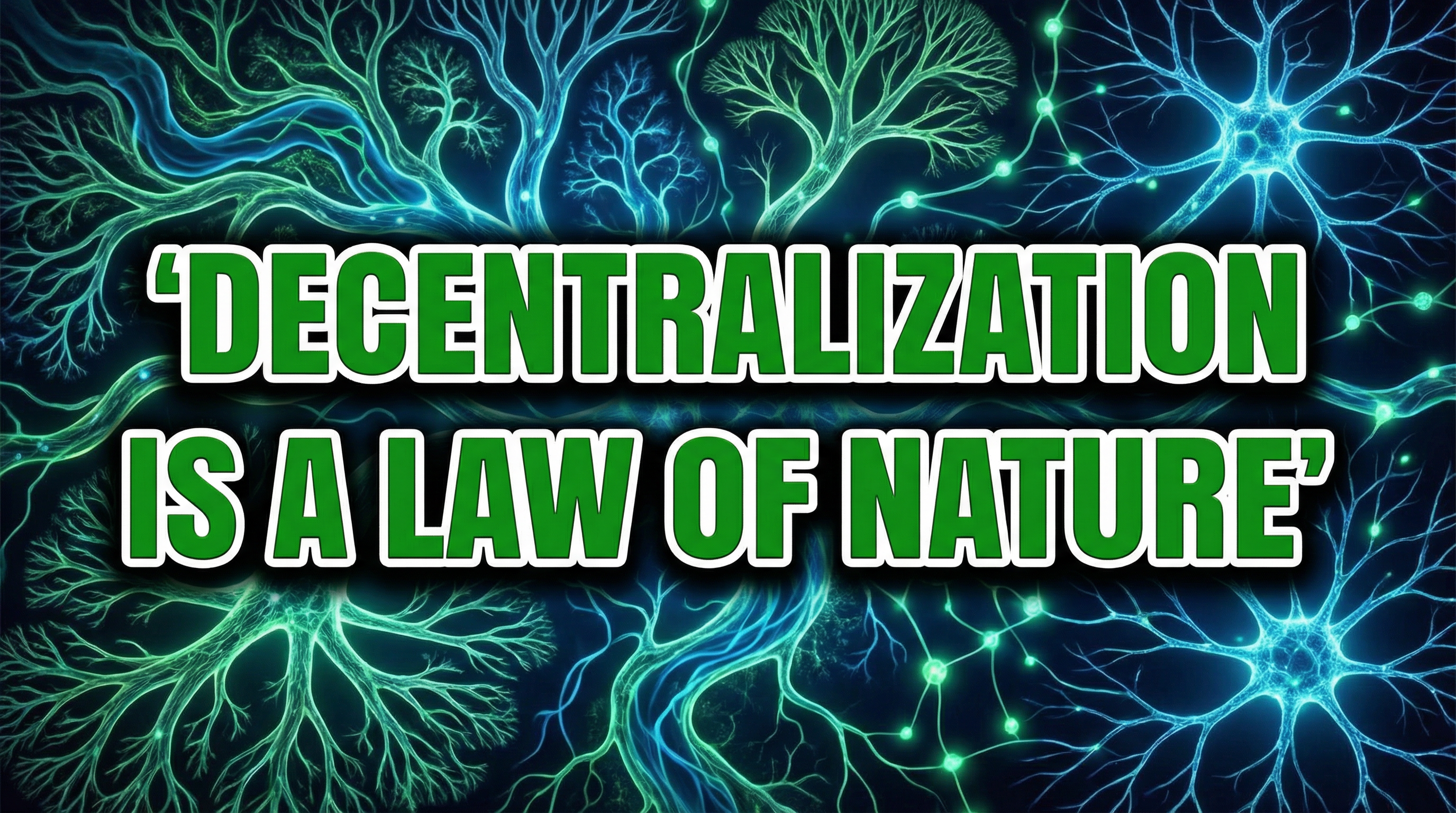
Decentralization is a Law of Nature
Bitcoin. DAOs. Remote work. The trend toward decentralization isn't ideology—it's physics. Why distributed systems outperform centralized ones.
Full Article
Decentralization is a Law of Nature
The Illusion of Control
You think you’re in control, don’t you? You’ve got your five-year plan, your meticulously organized calendar, and a savings account that’s growing at a predictable, comfortable rate. You’ve built a little kingdom, and you are its benevolent ruler. Bullshit. The universe is laughing at your plans. It’s a chaotic, swirling vortex of energy and information, and it couldn’t care less about your color-coded spreadsheets.
We’re obsessed with control. We build centralized institutions—governments, corporations, banks—thinking they’ll protect us from the scary, unpredictable world out there. We crave order, stability, and the comforting illusion that someone, somewhere, has their hands on the wheel. But what if I told you that this entire worldview is fundamentally flawed? What if I told you that the universe is actively working against your desire for control? That, in fact, the very laws of physics favor decentralization, distribution, and what looks a hell of a lot like chaos.
This isn’t some new-age, woo-woo philosophy. This is hard science. And understanding it will change the way you see everything, from the money in your bank account to the way you structure your life.
The Problem: Our Addiction to the Center
Most people are what I call “Backward-Looking People,” or BLPs. They’re clinging to an outdated model of the world, a model that says centralization is safe and decentralization is dangerous. They see a company with a powerful CEO, a government with a strong leader, or a financial system with a central bank, and they feel a sense of security. They believe that order must be imposed from the top down.
This is the comfort of the known, the safety of the herd. It’s the belief that if we just put the right person in charge, everything will be okay. But this is a dangerous fantasy. Centralized systems are fragile. They create single points of failure. They concentrate power, which inevitably leads to corruption and abuse. And most importantly, they are fighting a losing battle against the fundamental laws of the universe.
Think about it. A centralized system is like a sandcastle. It’s beautiful and orderly, but it’s built on a foundation of shifting sand. The tide is coming in, and that tide is entropy. The universe is constantly moving towards a state of greater disorder, and your neat little sandcastle is directly in its path. You can build the walls higher, you can dig the moat deeper, but eventually, the ocean is going to win. It always does.
The Application: The Great Unraveling
Once you understand this fundamental principle, you start to see it everywhere. The world is decentralizing, and it’s happening at an accelerating pace.
Bitcoin vs. Traditional Finance: For centuries, we’ve relied on centralized banks and governments to manage our money. But this system is opaque, inefficient, and prone to manipulation. Bitcoin, on the other hand, is a decentralized, peer-to-peer network. There is no central authority, no CEO, no one to shut it down. It’s a system that is governed by mathematics and cryptography, not by the whims of a few powerful individuals. It’s a direct challenge to the old way of doing things, and it’s winning.
DAOs vs. Corporations: The traditional corporate structure is a relic of the industrial age. It’s a top-down, hierarchical system that stifles innovation and concentrates power in the hands of a few. Decentralized Autonomous Organizations, or DAOs, are a radical new way of organizing people and resources. They are governed by smart contracts on a blockchain, and decisions are made by the community, not by a board of directors. It’s a more transparent, equitable, and efficient way to work together, and it’s the future of business.
Remote Work vs. The Office: The pandemic was a wake-up call. It forced us to question the assumption that we all need to be in the same physical location to be productive. The rise of remote work is a massive shift towards a more decentralized workforce. It’s giving people more freedom and autonomy, and it’s forcing companies to rethink their entire way of operating. The genie is out of the bottle, and it’s not going back in.
These are not isolated trends. They are all part of a larger pattern, a global shift away from centralization and towards a more distributed, resilient, and adaptable way of life. This is the arrow of time in action. The past doesn’t exist. We can’t go back to the old way of doing things. The only way is forward.
The Takeaway: Become a Forward-Looking Person
So, what does this all mean for you? It means you have a choice. You can be a Backward-Looking Person, clinging to the illusion of control and waiting for the tide to wash you away. Or you can be a Forward-Looking Person, someone who embraces the chaos, adapts to the changing environment, and learns to surf the edge of equilibrium.
Here’s how to start:
- Educate yourself: Learn about far-from-equilibrium thermodynamics, the endocannabinoid system, and the technologies of decentralization like Bitcoin and DAOs. The more you understand, the less you’ll fear the chaos.
- Decentralize your life: Look for ways to reduce your reliance on centralized systems. Diversify your investments. Build a network of trusted friends and colleagues. Learn new skills that will make you more adaptable and resilient.
- Embrace uncertainty: Stop trying to plan everything. The universe is going to throw you curveballs. The key is not to avoid them, but to learn how to hit them. Be flexible, be adaptable, and be open to new possibilities.
This isn’t just about making more money or being more successful. It’s about aligning yourself with the fundamental laws of the universe. It’s about living a life that is more resilient, more fulfilling, and more in tune with the way things really are.
Closing
The world is changing, whether you like it or not. The old structures are crumbling, and new ones are emerging. You can either be a victim of this change, or you can be a participant. You can either be a BLP, clinging to the past, or an FLP, embracing the future.
The choice is yours.
Comments
Related Articles
Deprogram Your Mind
The Plant That Evolved With Us

Why Prohibition Makes No Scientific Sense
The 2% Mindset
Want More?
Subscribe to The Forward Look on YouTube to get notified when new episodes drop.
Subscribe