Skin Cancer, Scarred Lungs, and the Repair System Nobody Told You About
Three papers dropped this morning from completely different disease territories — melanoma, pulmonary fibrosis, alcohol addiction — and they all crashed into the same system. The endocannabinoid system is not a drug target. It's the repair machine.
Full Article
The digest hit my inbox at 6:52 this morning. Eighteen new papers.
I read three of them before I showered. Which says something about my priorities on a Saturday, I guess.
Here's the thing that set me off. It's a pattern I keep seeing — not in any single paper, but across papers that have nothing to do with each other. Researchers in Algeria studying skin cancer. A Chinese team working on lung scarring from chemotherapy. An international consortium doing a meta-analysis of brain chemistry in alcoholism.
These people are not collaborating. They're not in the same field. They don't share funding sources or journals or research traditions. And yet in each case, they open the same drawer when they're looking for an explanation.
I want to start with the lung paper because it's the one I can't stop thinking about. Cao and colleagues, PLOS ONE. Bleomycin-induced pulmonary fibrosis. Bleomycin is a cancer drug, and one of its nastiest side effects is that it triggers a fibrotic response in the lungs — scar tissue grows where functional tissue should be. Breathing becomes harder and harder. There's not a lot in the treatment toolkit.
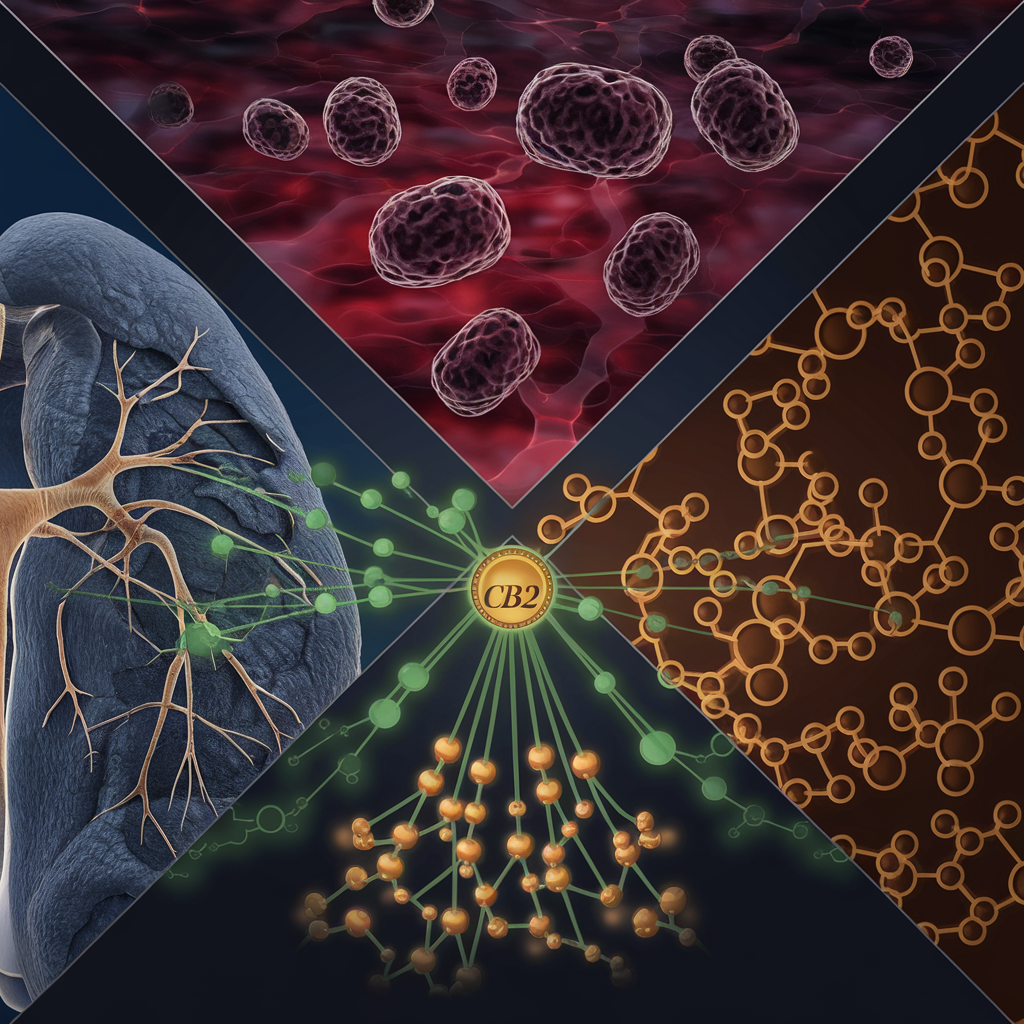
Cao's team activated CB2 receptors. The outcome: markedly less fibrosis, less inflammatory infiltration, better preserved lung architecture in the treated mice.
I need to explain what CB2 actually does because the pop-science version of the endocannabinoid system focuses almost entirely on CB1 — the brain receptor, the psychoactive one. CB2 is the other one. It lives in the immune system. Macrophages. T-cells. Dendritic cells. The whole defensive apparatus of your body.
And its function is resolution. It sends the stand-down signal. It's what tells the immune system: the threat has been neutralized, lower the inflammatory response, go home.
When that signal doesn't work right, inflammation doesn't resolve. And inflammation that doesn't resolve eventually destroys the tissue it was protecting. Fibrosis in the lungs. Joint destruction in rheumatoid arthritis. The tissue that gets replaced by scar isn't tissue anymore — it's the thermodynamic residue of a battle that never ended.
Bob Melamede had a particular phrase he used for this. He'd say the immune system had "forgotten how to finish." Inflammation is your body in a far-from-equilibrium attack state — burning massive energy to maintain a high-activity configuration. That's appropriate for an emergency. It's lethal as a permanent setting. CB2 is a key part of the mechanism that brings you back down.
Bouamri's paper out of Algeria is a different kind of thing — computational pharmacology, not animal research. His team did molecular docking and dynamics simulations of cannabis compounds against skin cancer target proteins. Five different proteins. And they didn't just look at THC and CBD. Cannabinol, cannabigerol, cannabichromene, a bunch of secondary compounds that most research ignores.
The finding: multiple compounds, multiple targets, simultaneously.
This is the entourage effect in a form that's hard to dismiss because it's coming out of rigorous computational modeling rather than anecdote or in vitro cell culture. The cannabis plant produces a chemical ecosystem, and different parts of that ecosystem hit different cancer mechanisms at the same time. The pharmaceutical model — one compound, one target, one patent — fundamentally cannot capture this.
There's an obvious next question: when do we get clinical trials? The answer is complicated and depressing. The FDA drug development pathway wasn't built for multi-compound plant extracts. The patent system can't protect something that grows in nature. So the financial incentive to run a $200M trial essentially doesn't exist, and the regulatory pathway is a nightmare even if you could find the money.
Bob found this infuriating and he had a right to.
The Costa meta-analysis in Molecular Psychiatry is the one that has the largest immediate public health implications. They pulled twenty-seven preclinical studies plus human data and looked at ECS involvement in alcohol use disorder.
Their conclusion: endocannabinoid system dysregulation is central to the development and maintenance of alcohol addiction. And crucially — this seems to precede and drive the behavior, not result from it.
I don't know how to convey how significant this should be if the medical establishment were actually paying attention. The alcohol treatment infrastructure in the United States and Europe is enormous and expensive and has success rates that would embarrass any other medical specialty. Some of what we do works for some people. But we're largely working on the wrong mechanisms.
The ECS is sitting there, dysregulated, driving the craving and the compulsive behavior and the inability to stop — and the treatment approach mostly ignores it entirely.
Bob used to talk about what he called "system blindness." When you don't know a system exists, you can't see it when it shows up as pathology. You end up treating the visible symptoms with tools aimed at other systems, and then you're confused when it doesn't fully work.
That's where we are with addiction.
Three papers. Fibrosed lungs. Melanoma. Alcoholic brains. Same drawer.
Bob spent his career at UCCS making exactly this argument — that the ECS is a distributed regulatory system present throughout the body because the body's need for adaptive regulation is distributed throughout the body. Maintaining complex ordered life against thermodynamic pressure isn't a one-organ job. The signaling network has to be everywhere.
The data has been building for thirty years. I've watched it build. The pile is substantial now.
At some point, somebody with institutional power is going to look at the pile.
Or they won't, and we'll keep treating symptoms while the regulatory system underneath sits ignored.
Either way, the papers keep coming.
References
- Bouamri LE et al. "Integrated Computational Investigation of Cannabis sativa Phytoconstituents as Putative Multi-Target Inhibitors in Skin Cancer." Pharmaceuticals (Basel). PubMed
- Cao C et al. "Protective effect of cannabinoid type II receptor ligand on bleomycin-induced pulmonary fibrosis in mice." PLoS One. PubMed
- Costa GPA et al. "Modulating the endocannabinoid system in alcohol use disorder: A translational systematic review and meta-analysis of preclinical and human studies." Mol Psychiatry. PubMed
- Ben-Shabat S et al. "Cannabinoids, the Blood-Brain Barrier, and Neurodegeneration: Mechanisms, Dysregulation, and Therapeutic Perspectives." Biomolecules. PubMed

Comments
Related Articles
The Most Important System You've Never Heard Of
Order From Chaos: The Secret of Life
The Physics Nobody Taught You
Lorazepam, PTSD, and Why the Alcohol Paradigm is Bullshit
Meth, Cocaine, and the Thermodynamic Forklifts
Want More?
Subscribe to The Forward Look on YouTube to get notified when new episodes drop.
Subscribe