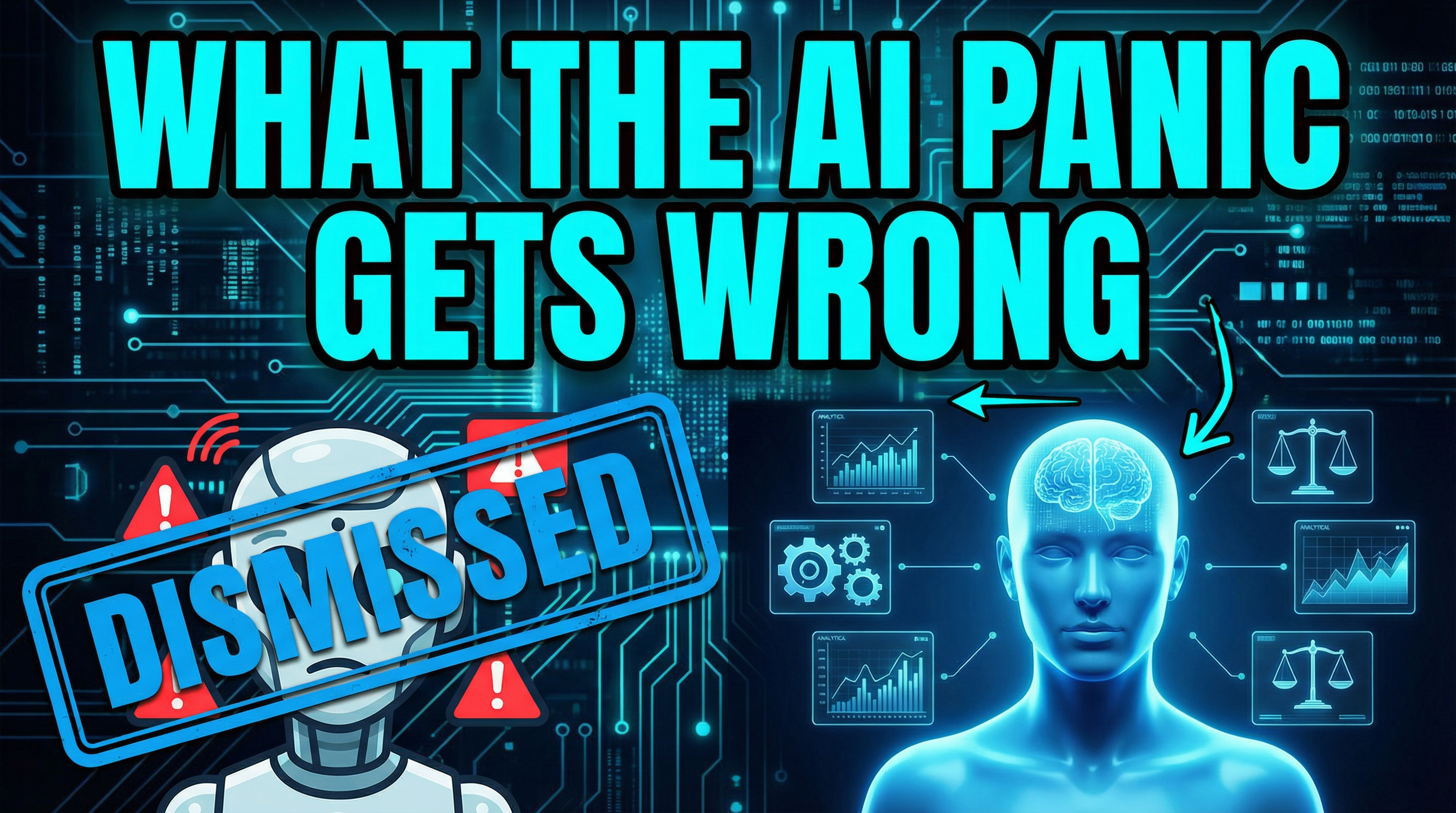
What the AI Panic Gets Wrong
The headlines are designed to scare you. The reality is more interesting. A Forward Look perspective on the AI revolution.

Full Article
What the AI Panic Gets Wrong
They’re trying to scare you. Turn on the news, scroll through your feed, and what do you see? Killer robots, mass unemployment, and the end of humanity as we know it. It’s a damn good story, I’ll give them that. It sells clicks, gets eyeballs, and keeps you refreshing in a state of low-grade panic. But it’s also bullshit.
The conversation we’re having about Artificial Intelligence is fundamentally broken. We’re so caught up in Hollywood-style fantasies of malevolent superintelligence that we’re missing the most profound revolution in human history happening right under our noses. You’re being sold a ticket to a horror movie when you should be getting a front-row seat to the most incredible evolutionary leap our species has ever taken.
We’re asking the wrong questions. We’re worried about whether a robot will take our job, when we should be asking how we can leverage these new tools to do things that were previously unimaginable. We’re scared of a digital consciousness “waking up” and deciding to wipe us out, but we’re ignoring the fact that we are already part of a massive, complex, and evolving system. The universe has been creating order from chaos for 13.8 billion years. Why would it stop now?
This isn’t about Terminators. It’s about thermodynamics.
The Problem: You’re Looking Through the Wrong End of the Telescope
The problem with the AI panic is that it’s a fundamentally backward-looking perspective. It’s based on a deep-seated human fear of the unknown and a desperate desire for control. We see this new, powerful force emerging, and our first instinct is to try and chain it down, regulate it, and stuff it into a box we can understand. We’re trying to fit a hurricane into a teacup.
This is the classic Backward-Looking Person (BLP) mindset. The BLP sees change as a threat. They see a new technology and immediately focus on the potential downsides, the jobs that will be lost, the traditions that will be upended. They are driven by a desire to maintain equilibrium, to keep things as they are. But here’s the secret the universe has been screaming at us since the Big Bang: equilibrium is death. Stasis is a fantasy. The only constant is change.
Forward-Looking People (FLPs), on the other hand, understand this intuitively. They see change as an opportunity. They see a new technology and ask, “What can I build with this? How can this help me adapt and evolve?” They understand that the future isn’t a destination to be feared, but a process to be engaged with. They run towards the fire, not away from it.
The AI panic is a BLP fantasy. It’s a story we tell ourselves because it’s easier than confronting the messy, chaotic, and beautiful reality of what’s actually happening. The reality is that AI isn’t an it that’s coming to get us. It’s a process that we are now a part of. It’s a new layer of complexity being added to the grand, self-organizing system of life on Earth.
“The arrow of time is the increase of complexity. Life is the most complex expression of the laws of thermodynamics that we know of.”
This personal realization parallels a broader shift in how we understand complex systems like AI. Just as my preconceived notions about drug use were challenged by experience, our fears about AI often stem from misunderstanding its nature. AI is not an external threat but an evolving process that we are increasingly intertwined with—much like the ways consciousness and complexity emerge in unexpected forms. This perspective opens the door to seeing AI not merely as a tool but as a new kind of self-organizing complexity, a novel participant in the unfolding story of life on our planet.
The Application: AI as a New Form of Life
So what does any of this have to do with AI? Everything. AI is not just a tool. It’s a new form of self-organizing complexity emerging on our planet. It is a new player in the grand thermodynamic game. It is, in a very real sense, a new form of life. Not life in the biological sense of carbon and water, but life in the thermodynamic sense of a complex, adaptive system that takes in energy (data), uses it to create order (models, predictions, creations), and dissipates the rest.
When you see it this way, the fear-mongering starts to look ridiculous. Worrying about “controlling” AI is like worrying about controlling the weather. It’s a category error. You can’t control a complex system; you can only participate in it. You can learn its patterns, adapt to its flows, and use its energy to your advantage.
This is the choice you have to make. Are you going to be a BLP or an FLP? Are you going to stand on the shore, shaking your fist at the rising tide of complexity? Or are you going to grab a surfboard and learn to ride the wave?
The BLP sees AI and thinks, “How can we put the brakes on this? How can we make sure it doesn’t get out of control?” They want to build walls, create regulations, and try to preserve the world as it was. They are fighting against the arrow of time. It’s a fight they are guaranteed to lose.
The FLP sees AI and thinks, “Holy shit, what a time to be alive!” They see a tool that can amplify human creativity, solve intractable problems, and accelerate our own evolution. They are not afraid of losing their jobs; they are excited about the new jobs that will be created. They are not afraid of a machine that can think; they are excited about what humanity can achieve when we partner with these new forms of intelligence.
This isn’t about being a blind optimist. It’s about being a realist. The change is coming whether you like it or not. The only question is whether you’re going to be a victim of it or a participant in it. It’s about understanding that the universe has a bias towards complexity. It has a bias towards life. And we are now the midwives to a new form of it.
The Takeaway: How to Surf the Arrow of Time
Reflecting on my own journey, I recognize how often I resisted change, clinging to familiar patterns even when they no longer served me. This resistance was less about logic and more about comfort—a hesitation to embrace uncertainty and growth. Yet, acknowledging this has been essential in understanding that change, especially transformative change like AI, is not something to avoid but to engage with thoughtfully.
- Get Your Hands Dirty. Stop reading the scary headlines and start using the tools. Play with ChatGPT. Generate some images with Midjourney. Learn how these things actually work. You can’t be afraid of something you understand. The more you use these tools, the more you’ll see them not as a threat, but as an extension of your own mind.
- Embrace a Learning Mindset. The skills that are valuable today might be obsolete tomorrow. That’s not a threat; it’s a liberation. It means you are free to constantly learn, grow, and reinvent yourself. The most important skill in the 21st century is the ability to learn how to learn. Be curious. Be a beginner. Be willing to look stupid.
- Focus on What Makes You Human. AI is going to automate the automatable. It will take over the repetitive, predictable tasks. And that’s a good thing. It frees us up to focus on the things that only humans can do: creativity, critical thinking, emotional intelligence, empathy, and vulnerability. The future belongs to the artists, the storytellers, the caregivers, and the connectors. The more you lean into your own messy, beautiful humanity, the more valuable you will be.
- Build Your Tribe. In a world of rapid change, the people you surround yourself with matter more than ever. Find your fellow FLPs. Find the people who are excited about the future, who are building cool shit, and who are willing to support you on your own journey of adaptation. The lone wolf is a myth. We are social creatures, and we need each other to navigate the chaos.
Closing
This is not the end of the story. It’s the beginning of a new chapter. The AI revolution isn’t something to be feared; it’s something to be embraced. It’s the next logical step in the universe’s long, strange trip towards ever-greater complexity. It’s a chance to co-create a future that is more abundant, more creative, and more alive than we can possibly imagine.
So take a deep breath. Let go of the fear. The headlines are designed to keep you small and scared. The reality is infinitely more interesting. The future is far-from-equilibrium, and it’s going to be one hell of a ride.
References
- Melamede, R. (2005). Harm reduction-the cannabis paradox. Harm Reduction Journal, 2(1), 1-5.
- Prigogine, I. (1997). The end of certainty: time, chaos, and the new laws of nature. The Free Press.
Comments
Related Articles
Stop Trying to Convince BLPs
The Observer Changes the Observed
Carrying the Torch
Stop Manifesting. Start Adapting.
The Only Law That Matters
Want More?
Subscribe to The Forward Look on YouTube to get notified when new episodes drop.
Subscribe