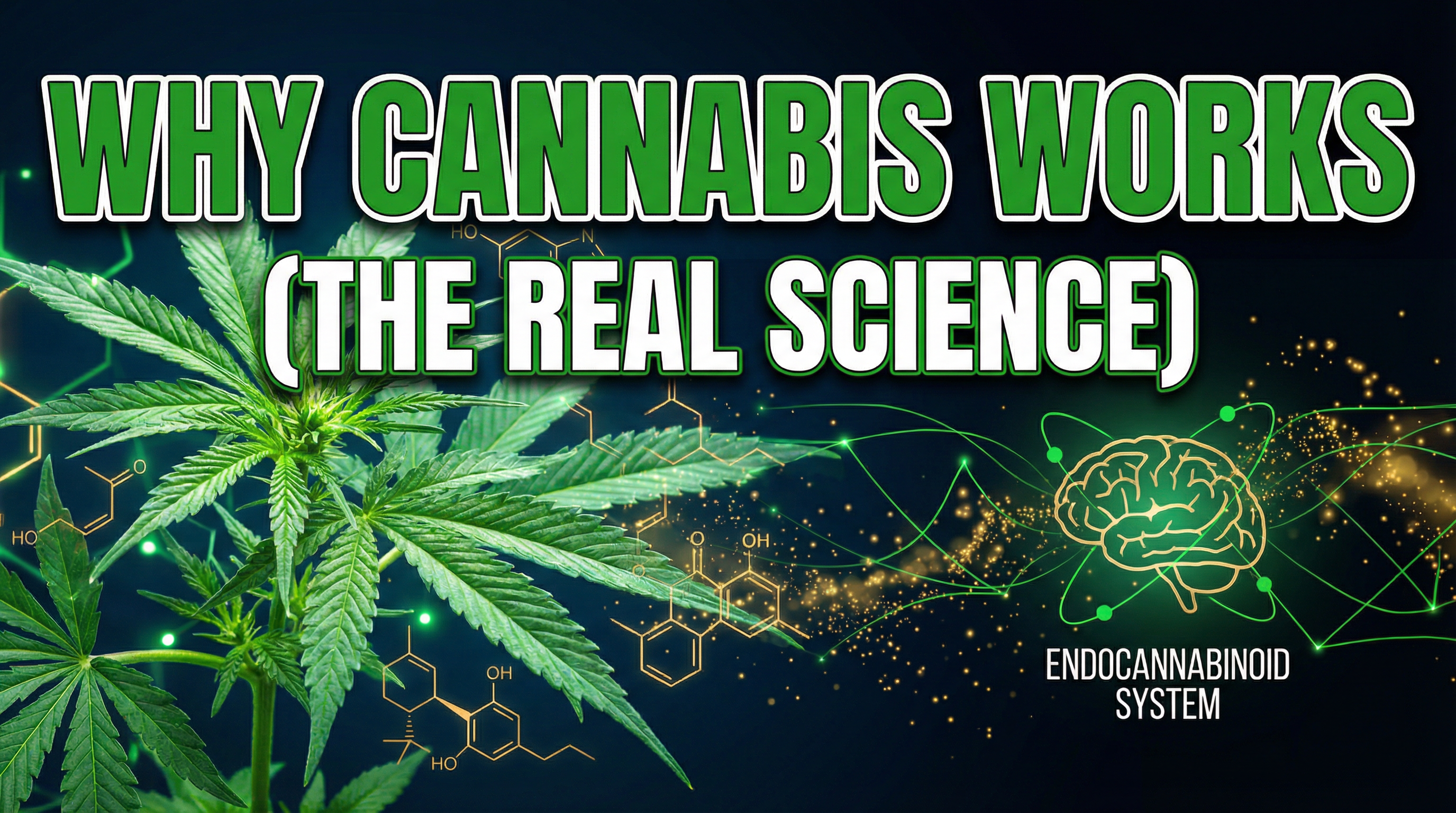
The Endocannabinoid System and Far-From-Equilibrium Thermodynamics: Why Cannabis Actually Works
Not stoner science. Real science. Peer-reviewed, Nobel Prize-adjacent science. How cannabinoids interface with your biology to create real effects.
Full Article
The Endocannabinoid System and Far-From-Equilibrium Thermodynamics: Why Cannabis Actually Works
Or: How I Learned to Stop Worrying and Trust the Science
Let me ask you something. What if I told you that the universe is actively trying to get you high? Not in some woo-woo, cosmic-consciousness sense, but in a cold, hard, biological sense. What if I told you that the same forces that dictate the arrow of time and the expansion of the universe are at play within your own body, and that cannabis is a key to unlocking your potential to navigate it all?
You'd probably think I'm full of shit. And that's okay. I'm used to it.
But here's the thing: I'm not making this up. This is peer-reviewed, Nobel Prize-winning science. And by the end of this paper, you're either going to understand why cannabis works at a fundamental level—or you're going to prove my point about why some people can't update their mental models. Either way, we're going to learn something.
1. The Problem: A Century of Bullshit
For decades, the conversation around cannabis has been dominated by stoner science and corporate propaganda. On one side, you have Cheech and Chong, giggling about munchies and short-term memory loss. On the other, you have talking heads warning of reefer madness and gateway drugs. It's all bullshit. The real story—the one that's been buried under a mountain of misinformation—is far more interesting and a hell of a lot more important.
The problem isn't that people are stupid. It's that they've been lied to. For almost a century, we've been fed a steady diet of fear and ignorance when it comes to cannabis. The result is a population that either sees it as a harmless party drug or a one-way ticket to skid row. Both are wrong. Both miss the point entirely.
The real science of cannabis isn't about getting fucked up. It's about understanding the fundamental nature of life itself.
Let me say that again, because it's important: The endocannabinoid system is not some peripheral curiosity. It is a master regulatory system that governs virtually every physiological process in your body. Your immune system. Your cardiovascular system. Your nervous system. Your digestive system. Your reproductive system. Your bones. Your skin. Everything.
And yet—and here's where it gets infuriating—the endocannabinoid system is barely mentioned in medical schools. A survey of 158 U.S. medical schools found that only 13% even mention the word "endocannabinoid." The most abundant neurotransmitter system in the human brain, and we don't teach doctors about it.
This isn't an oversight. It's institutional malpractice.
2. The Framework: Life as a Thermodynamic Phenomenon
To understand why cannabis works, you first have to understand what life is. And I don't mean that in some philosophical, navel-gazing sense. I mean it in a rigorous, physical sense.
2.1 Enter Ilya Prigogine
Ilya Prigogine won the Nobel Prize in Chemistry in 1977 for his work on far-from-equilibrium thermodynamics. If you haven't heard of him, don't feel bad—most people haven't. But his work is foundational to understanding everything I'm about to tell you.
Here's the core insight: Living systems are not machines. They are dissipative structures.
What does that mean? It means that you are not a static object. You are a process. You are a pattern of energy and matter that maintains its organization by continuously exchanging resources with your environment. You eat. You breathe. You excrete. You radiate heat. Stop any of these processes, and you die. You equilibrate. You become a corpse—which is just a fancy way of saying you become a random distribution of molecules.
Prigogine showed that when energy flows through a system, that system can spontaneously generate and maintain organized structures. This is counterintuitive if you've been taught that entropy always increases (the Second Law of Thermodynamics). But here's the key: entropy must increase in a closed system. Living systems are not closed. They're open. They maintain their internal order by exporting disorder to their surroundings.
As Prigogine put it: "The more deeply we study the nature of time, the better we understand that duration means invention, creation of forms, continuous elaboration of the absolutely new."
In other words: The universe is not winding down. It's winding up. And you are part of that process.
2.2 The Belousov-Zhabotinsky Reaction: Proof of Concept
If this sounds too abstract, let me give you a concrete example. There's a chemical reaction called the Belousov-Zhabotinsky reaction. You take a petri dish, add some chemicals, and watch what happens.
What happens is impossible. Or at least, it should be impossible according to classical thermodynamics.
The liquid spontaneously organizes itself into patterns. Spirals. Waves. Oscillations. Structure emerges from chaos—not because someone designed it, but because the flow of energy through the system makes organization thermodynamically favorable.
When Belousov first tried to publish this result in the 1950s, the journal editors rejected it. "This violates the Second Law of Thermodynamics," they said. "It can't be true."
But it was true. They were just looking at it wrong.
This is the same mistake we've made with cannabis. We've been looking at it through the wrong lens—a reductionist, mechanistic lens that can't account for the emergent properties of complex systems. To understand cannabis, you have to understand that you are not a machine. You are a dissipative structure. You are a far-from-equilibrium thermodynamic system. And the endocannabinoid system is one of the primary mechanisms by which you maintain your distance from equilibrium.
In plain English: The ECS keeps you alive by keeping you organized.
3. The Mechanism: How the ECS Actually Works
3.1 Free Radicals: The Friction of Life
Here's something they don't tell you in health class: every time you generate energy, you also generate damage.
Your cells produce ATP (the energy currency of life) through a process called oxidative phosphorylation. It's efficient as hell—you get about 36 ATP molecules from a single glucose molecule. But there's a catch. The process leaks. And what it leaks are free radicals.
Free radicals are molecules with unpaired electrons. They're reactive. They want to bond with something. And when they bond with your DNA, your proteins, or your cell membranes, they cause damage. This is called oxidative stress, and it's implicated in virtually every age-related disease you can name: cancer, cardiovascular disease, neurodegeneration, autoimmune disorders. The works.
Now, here's where it gets interesting. Free radicals aren't just bad. They're also signals. They're how your cells communicate metabolic status. They're how your body knows when something is wrong and needs to be fixed.
The problem isn't free radicals per se. The problem is too many free radicals. The problem is when the damage outpaces the repair.
Free radicals are the friction of life. And cannabinoids are the oil.
3.2 The Metabolic Switch
The endocannabinoid system regulates the balance between two fundamental metabolic modes:
- Mode 1: Carbohydrate Metabolism (CB1-Mediated)
- Efficient energy production
- High free radical generation
- Associated with cellular activity and growth
- Think of this as "go mode"
- Mode 2: Lipid Metabolism (CB2-Mediated)
- Less efficient energy production
- Lower free radical generation
- Associated with cellular repair and autophagy
- Think of this as "repair mode"
Your cells need both modes. When you're active, when you're thinking, when you're doing things, you need efficient energy production. But that efficiency comes at a cost—oxidative damage. So your cells also need to periodically shift into repair mode, clean up the damage, and restore homeostasis.
The ECS is the switch. It's how your body decides when to push and when to recover. It's how you maintain the dynamic balance that keeps you alive.
And here's the kicker: Cannabis works because it speaks the same language as your endocannabinoid system. THC, CBD, and the other phytocannabinoids bind to the same receptors that your endogenous cannabinoids bind to. They modulate the same pathways. They help your body do what it's already trying to do—maintain homeostasis in a world that's constantly trying to knock you off balance.
3.3 Retrograde Signaling: The Brain's Built-In Circuit Breaker
In the nervous system, the ECS does something remarkable. It works backwards.
Most neurotransmitters travel from the presynaptic neuron to the postsynaptic neuron. Endocannabinoids do the opposite. When a postsynaptic neuron gets overstimulated—when it's experiencing too much excitatory input and generating too many free radicals—it synthesizes endocannabinoids on demand. These lipid messengers travel backward across the synapse and tell the presynaptic neuron to calm the hell down.
This is called retrograde signaling, and it's essentially a built-in circuit breaker. It prevents excitotoxicity—the process by which neurons literally excite themselves to death.
This is why cannabis is neuroprotective. This is why it helps with epilepsy, with neuroinflammation, with traumatic brain injury. It's not magic. It's mechanism. The plant is doing what your brain is already trying to do, just more effectively.
4. The Implications: Aging, Disease, and Why We're All Slowly Dying
4.1 Aging as Thermodynamic Decay
Here's a depressing thought: you are dying right now. Not in some abstract, philosophical sense. In a literal, thermodynamic sense. Every moment of every day, you are moving closer to equilibrium. Your cells are accumulating damage. Your repair mechanisms are becoming less efficient. Your distance from equilibrium is shrinking.
This is aging. This is what it means to get old. You're not wearing out like a machine. You're equilibrating like a chemical reaction.
The good news is that this process is not fixed. It's modifiable. And one of the primary modulators is the endocannabinoid system.
Studies on CB1 knockout mice—mice that have been genetically engineered to lack the CB1 receptor—show accelerated aging and premature death. These mice can't get high. They also can't live as long. The receptor that the government has spent billions of dollars trying to prevent you from activating is the same receptor that keeps you alive.
Let that sink in for a moment.
4.2 Age-Related Disease as ECS Dysfunction
The major killers in the developed world—cardiovascular disease, cancer, neurodegeneration, autoimmune disorders—share common features:
- Chronic inflammation
- Oxidative stress
- Metabolic dysregulation
- Impaired cellular repair
Every single one of these processes is modulated by the ECS. Every single one of these diseases is, at some level, a disease of endocannabinoid dysfunction.
This doesn't mean cannabis is a panacea. It's not. But it does mean that the ECS is a legitimate therapeutic target for a wide range of conditions. And it means that the blanket prohibition of cannabinoids has almost certainly cost lives.
How many lives? We don't know. We can't know, because we weren't allowed to do the research. That's the real crime here. Not that people got high. That people died because we were too afraid to ask the right questions.
5. The Phenotype: Are You a FLP or a BLP?
This isn't just abstract science. It has profound implications for how we live our lives. It forces us to ask a fundamental question: Are you a Forward-Looking Person (FLP) or a Backward-Looking Person (BLP)?
5.1 The Morris Water Maze
There's a classic experiment in neuroscience called the Morris water maze. You put a mouse in a tank of cloudy water with a hidden platform. The mouse swims around, finds the platform, and learns its location. Simple enough.
Now here's where it gets interesting. You move the platform. Normal mice—wild-type mice with intact CB1 receptors—adapt. They search for the platform in the old location, don't find it, explore, find the new location, and update their mental model. They learn.
CB1 knockout mice can't do this. They find the old location, don't find the platform, and keep going back to the old location. Over and over. They learned the first location just fine. But they can't unlearn it. They can't update their model. They're stuck.
They are, quite literally, backward-looking.
5.2 The Human Implications
Now, humans aren't mice. But the principle holds. Endocannabinoid tone—the baseline level of ECS activity—varies across individuals. And this variation has measurable consequences.
People with higher endocannabinoid tone tend to be:
- More psychologically resilient
- More cognitively flexible
- Less anxious
- More open to new experiences
- More optimistic about the future
People with lower endocannabinoid tone tend to be:
- More stress-reactive
- More cognitively rigid
- More anxious
- More resistant to change
- More focused on threats
This isn't destiny. Endocannabinoid tone is modifiable. Diet, exercise, stress management, and yes, phytocannabinoids can all shift the dial. But it does suggest that some people are, at a biological level, better equipped to handle change than others.
5.3 The Political Implications
I'm going to say something controversial here, and I want you to really think about it before you react.
Research has shown that political orientation correlates with physiological traits. People who identify as liberal tend to show stronger activity in the anterior cingulate cortex—a brain region associated with cognitive flexibility and conflict monitoring. People who identify as conservative tend to show stronger amygdala responses to threatening stimuli.
The anterior cingulate cortex is rich in cannabinoid receptors.
I'm not saying that conservatives are cannabinoid-deficient. I'm not saying that liberals are better. I'm saying that there may be a biological substrate to the way we process change and uncertainty. And I'm saying that understanding this substrate might help us have more productive conversations across ideological divides.
Or it might not. But it's worth thinking about.
6. The Application: What You Can Actually Do With This Information
Okay, enough theory. Let's talk practice. What can you actually do with this information?
6.1 Educate Yourself
Don't take my word for any of this. Read the science. Watch Dr. Bob Melamede's lectures on YouTube. Read Prigogine's Order Out of Chaos. Dig into the primary literature on the endocannabinoid system. The information is out there if you're willing to look for it.
A few starting points:
- Melamede, R. (2005). Cannabis and tobacco smoke are not equally carcinogenic. Harm Reduction Journal.
- Di Marzo, V. (2018). New approaches and challenges to targeting the endocannabinoid system. Nature Reviews Drug Discovery.
- Prigogine, I. (1997). The End of Certainty: Time, Chaos, and the New Laws of Nature.
It's dense reading. But it's worth it.
6.2 Support Your ECS Naturally
Even if you never touch cannabis, you can support your endocannabinoid system through lifestyle factors:
- Nutrition:
- Omega-3 fatty acids are precursors to endocannabinoid synthesis
- Your body literally makes cannabinoids out of fish oil
- This is why every doctor tells you omega-3s are good for your heart and brain—they just don't know why
- Exercise:
- Physical activity increases circulating endocannabinoid levels
- The "runner's high" is partially mediated by anandamide, not just endorphins
- Regular exercise upregulates ECS function
- Stress Management:
- Chronic stress depletes endocannabinoid reserves
- Meditation, sleep, and social connection support ECS recovery
- This isn't woo-woo. It's biochemistry.
6.3 Experiment Responsibly
If you live in a jurisdiction where cannabis is legal, consider experimenting with it in a safe and responsible way. But do it like a scientist, not like a frat boy.
Principles:
- Start with low doses. Lower than you think.
- Keep a journal. Track effects on mood, creativity, focus, sleep, pain.
- Try different strains and consumption methods. They're not all the same.
- Find the minimum effective dose. The goal isn't to get as high as possible. The goal is to find the dose that helps you function better.
- Pay attention to set and setting. Context matters.
The goal isn't intoxication. The goal is optimization.
6.4 Embrace Adaptation
This is the meta-lesson. The most important thing you can take from all of this isn't about cannabis specifically. It's about the mindset.
Start to see yourself not as a static object, but as a dynamic process. You are not a thing. You are a pattern. You are a dissipative structure maintaining itself far from equilibrium through continuous exchange with your environment.
This means:
- Change is not just inevitable. It's necessary. It's how you stay alive.
- Rigidity is death. Flexibility is life.
- The goal isn't to find the right answer and hold onto it forever. The goal is to continuously update your model based on new information.
This is what it means to be a Forward-Looking Person. It's not about having all the answers. It's about being willing to ask the right questions. It's about recognizing that you are a complex, self-organizing system, and that your potential for growth is limitless—if you're willing to embrace the chaos.
7. Conclusion: The River and the Raft
The universe is not a clockwork machine. It's a raging, chaotic, beautiful river. You can either spend your life trying to swim against the current, or you can learn to build a raft.
The endocannabinoid system is part of your raft. It's one of the primary mechanisms by which your body navigates the thermodynamic chaos of existence. It keeps you organized. It keeps you adaptive. It keeps you alive.
Cannabis isn't a drug in the way we usually think about drugs. It's a tool. It's a key that fits a lock that evolution spent 500 million years designing. Used wisely, it can help you become more adaptive, more resilient, more creative, more alive.
Used stupidly, it can make you a stereotype. Don't be a stereotype.
The choice is yours. It always has been.
But now, at least, you understand what you're choosing between.
References
Prigogine, I., & Stengers, I. (1984). Order Out of Chaos: Man's New Dialogue with Nature. Bantam Books.
Prigogine, I. (1997). The End of Certainty: Time, Chaos, and the New Laws of Nature. Free Press.
Melamede, R. (2005). Cannabis and tobacco smoke are not equally carcinogenic. Harm Reduction Journal, 2(1), 21.
Melamede, R. (2005). Endocannabinoids: Multi-scaled, global homeostatic regulators of cells and society. International Association for Cannabinoid Medicines.
Di Marzo, V., & Piscitelli, F. (2015). The endocannabinoid system and its modulation by phytocannabinoids. Neurotherapeutics, 12(4), 692-698.
Piomelli, D. (2003). The molecular logic of endocannabinoid signalling. Nature Reviews Neuroscience, 4(11), 873-884.
Cravatt, B. F., & Lichtman, A. H. (2004). The endogenous cannabinoid system and its role in nociceptive behavior. Journal of Neurobiology, 61(1), 149-160.
Mackie, K. (2006). Cannabinoid receptors as therapeutic targets. Annual Review of Pharmacology and Toxicology, 46, 101-122.
Bilkei-Gorzo, A. (2012). The endocannabinoid system in normal and pathological brain ageing. Philosophical Transactions of the Royal Society B, 367(1607), 3326-3341.
Zimmer, A., et al. (1999). Increased mortality, hypoactivity, and hypoalgesia in cannabinoid CB1 receptor knockout mice. Proceedings of the National Academy of Sciences, 96(10), 5780-5785.
Akirav, I. (2011). The role of cannabinoids in modulating emotional and non-emotional memory. Frontiers in Behavioral Neuroscience, 5, 34.
Hill, M. N., & Patel, S. (2013). Translational evidence for the involvement of the endocannabinoid system in stress-related psychiatric illnesses. Biology of Mood & Anxiety Disorders, 3(1), 19.
Russo, E. B. (2016). Clinical endocannabinoid deficiency reconsidered: Current research supports the theory in migraine, fibromyalgia, irritable bowel, and other treatment-resistant syndromes. Cannabis and Cannabinoid Research, 1(1), 154-165.

Comments
Related Articles
The Only Law That Matters
Cannabis and Enlightenment
Why Comfort is Killing You
Why Some People Can't Handle Change

Flow State: Where East Meets West
Want More?
Subscribe to The Forward Look on YouTube to get notified when new episodes drop.
Subscribe