Why Eastern Religions Got It Right
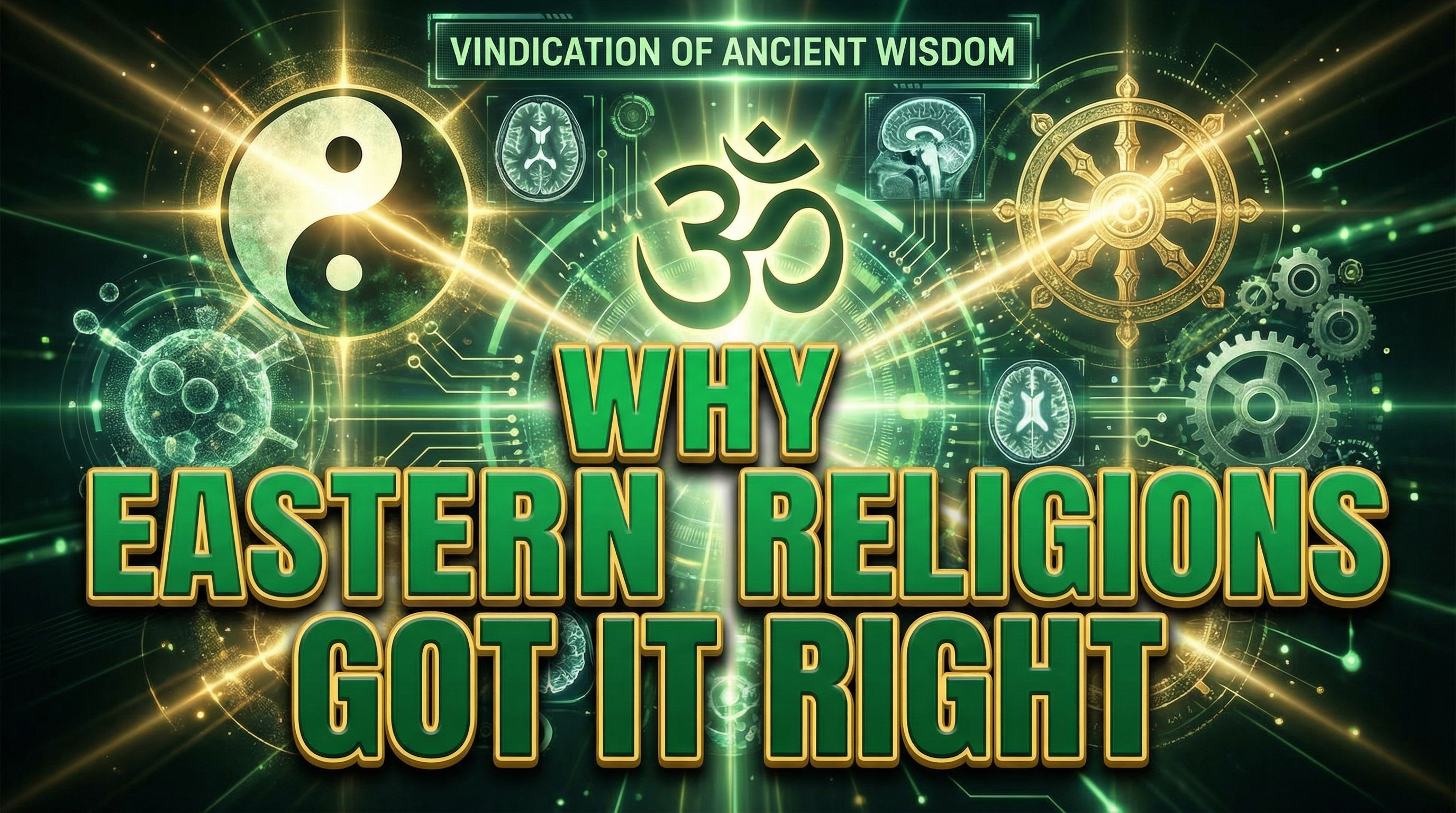
Hinduism, Buddhism, Taoism—they all point to flow, impermanence, non-resistance. Western science is finally catching up. The convergence.
Full Article
You Don’t Need Balance. You Need to Get in the River.
You think you need balance in your life? Bullshit.
That’s right, I said it. The whole concept of “work-life balance” that corporate HR drones and self-help gurus are peddling is one of the most pervasive and destructive lies of our time. It’s a fantasy, a carrot on a stick designed to keep you docile and chasing an impossible ideal. The universe doesn’t do balance. It does chaos. It does flow. And from that chaos, it creates everything worth a damn, including you.
We’ve been sold a bill of goods. The idea that you should be seeking a state of perfect, static equilibrium is not just wrong, it’s thermodynamically impossible. Life isn’t a serene pond; it’s a raging river. And your only choice is to learn how to navigate it, or you’ll drown clinging to the shore.
The Problem: The Western Lie of a Balanced Life
For decades, we’ve been indoctrinated with the gospel of balance. We’re told to balance our diets, balance our checkbooks, and, most importantly, balance our work and our personal lives. The image is always one of a perfectly still scale, with equal weights on either side. It sounds nice, doesn’t it? Peaceful. Zen. The only problem is, it’s a recipe for stagnation and death.
Think about it. What in nature is truly in a state of perfect equilibrium? A rock. A corpse. A dead star. Equilibrium is the end of the line, the final state where nothing interesting happens. It’s heat death. It’s the cessation of the flow of energy that defines life itself. When you’re striving for balance, you’re subconsciously striving for the grave.
This obsession with stasis makes us fragile. We build rigid plans and five-year goals, and then we’re shattered when reality inevitably throws a wrench in the works. We resist change, we fear uncertainty, and we cling to the past like a security blanket. We become Backward-Looking People (BLPs), terrified of the forward march of time, desperately trying to hold things just as they are. It’s a losing battle, and it’s making us miserable, anxious, and sick.
The Application: Ancient Wisdom, Modern Science
The most fascinating part of all this is that while Western science is just catching up to these ideas, Eastern philosophies have been talking about them for thousands of years. They didn’t have the language of thermodynamics, but they understood the fundamental nature of reality through deep, intuitive insight.
Take Buddhism. A core tenet is impermanence (Anicca). The idea that everything is in a constant state of flux, that nothing is permanent. This is a perfect philosophical reflection of the Arrow of Time and the nature of a far-from-equilibrium system. The Buddhist practice of non-attachment is a survival strategy for a universe where everything is temporary. You don’t cling to things, because clinging creates suffering in a world that is guaranteed to change.
Or look at Taoism. The central concept of Wu Wei is often translated as “effortless action.” It’s not about being lazy or passive. It’s about acting in harmony with the natural flow of the universe, the Tao. It’s about sensing the current of the river and using its power to guide you, rather than trying to paddle against it. This is the practical application of living in a far-from-equilibrium world. You adapt, you don’t resist. You become like water, which is soft and yielding but can overcome anything hard and rigid.
Even in Hinduism, you see these concepts. The idea of Lila describes the universe as a form of divine play. It’s not a serious, static, predetermined affair; it’s a dynamic, creative, and often chaotic dance. The trinity of Brahma (the creator), Vishnu (the preserver), and Shiva (the destroyer) represents the constant cycle of creation, maintenance, and dissolution that characterizes all complex, self-organizing systems.
Reflecting on my own journey, I realize how often I resisted change and clung to things that no longer served me. Like many, I made decisions rooted in fear and ego, struggling to embrace the fluid, ever-changing nature of life that concepts like Lila so beautifully illustrate. Recognizing this has been crucial in moving towards a more open and dynamic way of living.
The Takeaway
So, what does this mean for you, right now, in your life? This isn’t just abstract philosophy. It’s a practical guide to a better way of living.
First, stop chasing ‘balance.’ It’s a mirage. Instead, focus on building resilience and adaptability. How quickly can you recover from a setback? How well can you pivot when a new opportunity, or a new threat, appears? That’s the true measure of a healthy system.
Second, embrace impermanence. Meditate on it. Feel it in your bones. The job you have now, the relationship you’re in, the person you are today—it’s all temporary. This isn’t a cause for despair; it’s a source of liberation. When you stop clinging, you become free to move and adapt. You are a process, not a static object.
Third, listen to your Endocannabinoid System. Your body is giving you signals all the time. Are you constantly stressed, anxious, and inflamed? Is your sleep a wreck? That’s your ECS screaming at you that you’re fighting the current. It’s a sign that you are living a life of resistance. Pay attention. Make changes.
Finally, practice ‘beneficial stress,’ or what scientists call hormesis. Our systems are designed to be challenged. They don’t grow stronger in a comfortable, static environment. They grow stronger when they are forced to adapt to manageable stressors. Exercise, intermittent fasting, learning a new skill—these are all ways to introduce beneficial stress that makes your entire system more robust and resilient.
Closing
The ancient sages of the East looked at the world and saw a dynamic, flowing, and interconnected reality. They understood that the key to a good life was not to resist this flow, but to harmonize with it. Now, thousands of years later, our most advanced science is telling us the exact same thing. Far-from-equilibrium thermodynamics is the scientific validation of ancient wisdom.
Stop trying to find your center. Stop trying to achieve some mythical state of balance. It’s a fool’s errand. The action isn’t at the center; it’s on the edge. Get out of the calm, stagnant shallows and get in the damn river.
***
Comments
Related Articles
Buddhism and the Arrow of Time
The Stoner Stereotype is Dead
The Skillset Cannabis Unlocks
The Problem With Regulation
IKE: The World Is What You Think It Is
Want More?
Subscribe to The Forward Look on YouTube to get notified when new episodes drop.
Subscribe