Why You Can't Organize Stoners (And Why That's the Point)
Cannabis doesn't just change how you think—it changes how you follow. Or more precisely, it makes you stop following. The plant that dissolves hierarchy is evolution's antidote to authoritarian control.
Full Article
Why You Can't Organize Stoners (And Why That's the Point)
The Paradox Nobody Talks About
There's a question hiding in plain sight that the entire cannabis world has been too stoned — or too polite — to ask out loud.
The cannabis industry—the legal one, the black market one, the advocacy one, all of them—has never been able to organize the way alcohol, tobacco, pharmaceuticals, or law enforcement can. It's not for lack of trying. God knows people have tried. Trade associations, lobbying groups, unions, coalitions—they form, they splinter, they dissolve, they reform under a new name with the same dysfunction. Rinse and repeat.
Meanwhile, the cops? The Backward-Looking People (BLPs)? They organize like a military. Because they are a military. Rigid hierarchy. Chain of command. Uniforms. Badges. Follow the leader. Don't ask questions. Do what you're told.
And everyone in cannabis has always treated this as a weakness. "If only we could get our act together." "If only we could organize like they do." "If only stoners would show up to vote like the gun lobby shows up to vote."
But what if the inability to organize isn't a bug? What if it's the feature? What if the very substance these people are consuming is the reason they can't—and shouldn't—organize like the opposition?
The plant itself makes you resistant to the kind of hierarchical thinking that organized opposition requires. Cannabis doesn't just alter your mood—it alters your relationship to authority.
What Cannabis Actually Does to Your Brain
Let's get into the neuroscience. This isn't woo-woo philosophy. This is what the endocannabinoid system actually does when you introduce phytocannabinoids.
1. Divergent thinking goes up. Cannabis, particularly THC, has been shown to increase what psychologists call "divergent thinking"—the ability to generate multiple solutions to a problem, to see connections between seemingly unrelated things. This is the opposite of convergent thinking, which narrows focus toward a single correct answer. Hierarchies run on convergent thinking. One answer. One leader. One way. Cannabis makes your brain do the opposite.
2. Default mode network activity shifts. The default mode network (DMN) is the part of your brain responsible for self-referential thinking—your sense of identity, your ego, your place in the social hierarchy. Cannabis modulates DMN activity, often loosening the grip of rigid self-concepts. When your sense of "I am this rank, in this position, following this leader" becomes more fluid, hierarchical obedience becomes harder. Not impossible. Just... less automatic.
3. Fear response is dampened. The endocannabinoid system plays a direct role in fear extinction—the process by which you stop being afraid of things that used to scare you. Hierarchy runs on fear. Fear of punishment. Fear of exclusion. Fear of the boss. When cannabis supports your ECS in processing and releasing fear, the primary enforcement mechanism of hierarchy loses its teeth.
4. Pattern recognition increases, but so does skepticism. Cannabis users often report seeing patterns they didn't notice before. But here's the key: they also become more skeptical of imposed patterns. The narrative your boss is selling. The story the government is telling. The "official version." Cannabis doesn't make you a conspiracy theorist—it makes you a pattern auditor. You start checking whether the patterns you're being told to see actually match reality.
5. Present-moment awareness crowds out future-threat obedience. Hierarchies motivate through projected futures: "Follow me or else bad things will happen." Cannabis pulls you into the present. It's harder to be terrorized by hypothetical consequences when you're deeply engaged with what's actually happening right now. This is far-from-equilibrium thinking in action—responding to actual conditions rather than projected fears.
The BLP Machine vs. The FLP Network
Now let's zoom out and look at this through the FLP/BLP framework.
BLPs organize through hierarchy. Top-down command. Clear ranks. Uniforms to erase individuality. Rules that must be followed without question. Punishment for deviation. Reward for compliance. It's the army, the police force, the corporate ladder, the church. It works—spectacularly—for maintaining the status quo. For preserving equilibrium.
FLPs organize through networks. Flat structures. Voluntary association. Shared interest rather than imposed order. Ideas that spread because they're good, not because someone with a badge said so. It's the open-source movement, the underground music scene, the startup ecosystem before the VCs show up. It's how nature actually organizes living systems.
And here's the deep insight: cannabis pushes your brain from hierarchy mode to network mode.
This is not a coincidence. This is not a side effect. This is the function of the endocannabinoid system as Dr. Bob Melamede understood it. The ECS exists to keep you adaptive, flexible, and responsive to novel conditions. It exists to prevent you from getting stuck in rigid patterns—including rigid social patterns like blind obedience to authority.
When you enhance your ECS with cannabis, you are literally upgrading your brain's resistance to hierarchical control. You become harder to lead by fear, harder to motivate by punishment, harder to organize through top-down command structures. You become, in the language of thermodynamics, a more complex dissipative structure—one that requires higher-quality information to organize, not just louder shouting from the top of a pyramid.
Why Prohibition Was Always About Control
Once you understand this, prohibition makes perfect sense. Not as public health policy—that was always the cover story. But as a control mechanism.
Think about it. What kind of society needs its citizens to be obedient, fearful, and responsive to hierarchical command? An authoritarian one. A militaristic one. A society organized around maintaining the power of those at the top of the pyramid.
Now what would happen if a significant portion of that society started consuming a substance that literally makes them worse at following orders? That makes them question authority? That makes them see through imposed narratives? That makes them harder to scare into compliance?
You'd ban it. Immediately. And you'd create a propaganda campaign to convince everyone that the substance makes people dangerous, lazy, and criminal. You'd associate it with minorities and countercultures to double down on the fear factor. You'd make possession a felony so that anyone who uses it can be removed from society. You'd create an entire enforcement apparatus—a hierarchy to enforce hierarchy—dedicated to stamping it out.
Sound familiar?
Harry Anslinger didn't ban cannabis because it was dangerous. He banned it because it was dangerous to the hierarchy. The War on Drugs was never about drugs. It was about maintaining the organizational structure that keeps BLPs in power.
The Evolutionary Argument
Here's where it gets even deeper. Dr. Bob used to talk about how the endocannabinoid system is the oldest neurotransmitter system in animals—it predates the serotonin system, the dopamine system, all of them. It's been fine-tuned by 600 million years of evolution. And its primary function? Adaptation.
The ECS exists to help organisms adapt to changing conditions. It modulates inflammation (the body's response to threat), it regulates mood (the mind's response to uncertainty), it influences appetite (the body's response to resource availability), and it modulates social behavior (the organism's response to group dynamics).
Cannabis plants co-evolved with this system. The phytocannabinoids in cannabis are structurally similar to endocannabinoids because the plant literally evolved to interface with animal nervous systems. This isn't an accident. This is co-evolution at its finest.
And what does this co-evolution produce? An organism that is more adaptive, more flexible, more creative, more skeptical of rigid structures, and more capable of navigating chaos. In other words: a Forward-Looking Person.
Evolution didn't make cannabis to help you relax on the couch. Evolution made cannabis to help you resist the kind of rigid, hierarchical thinking that leads species to extinction. Because species that can't adapt to change die. And hierarchy—beautiful, efficient, powerful hierarchy—is the most dangerous form of rigidity there is. It works until the environment changes. Then it collapses. Every time.
So What Do We Do?
Stop trying to organize stoners like an army. It will never work. And it shouldn't.
Instead, lean into what cannabis users actually are: a network. Networks don't need generals. They need good ideas. They don't need uniforms. They need shared values. They don't need chains of command. They need communication protocols.
The internet itself is proof that networks beat hierarchies in the long run. No one "leads" the internet. No one commands it. It's a flat, distributed, self-organizing system that has outperformed every hierarchical information system ever created. And it was built by people who think like FLPs.
The cannabis community doesn't need a leader. It needs better memes. Better arguments. Better science. Better stories. It needs to stop apologizing for its inability to look like the opposition and start recognizing that its organizational style—decentralized, adaptive, creative, resistant to top-down control—is actually the more evolved form of human social organization.
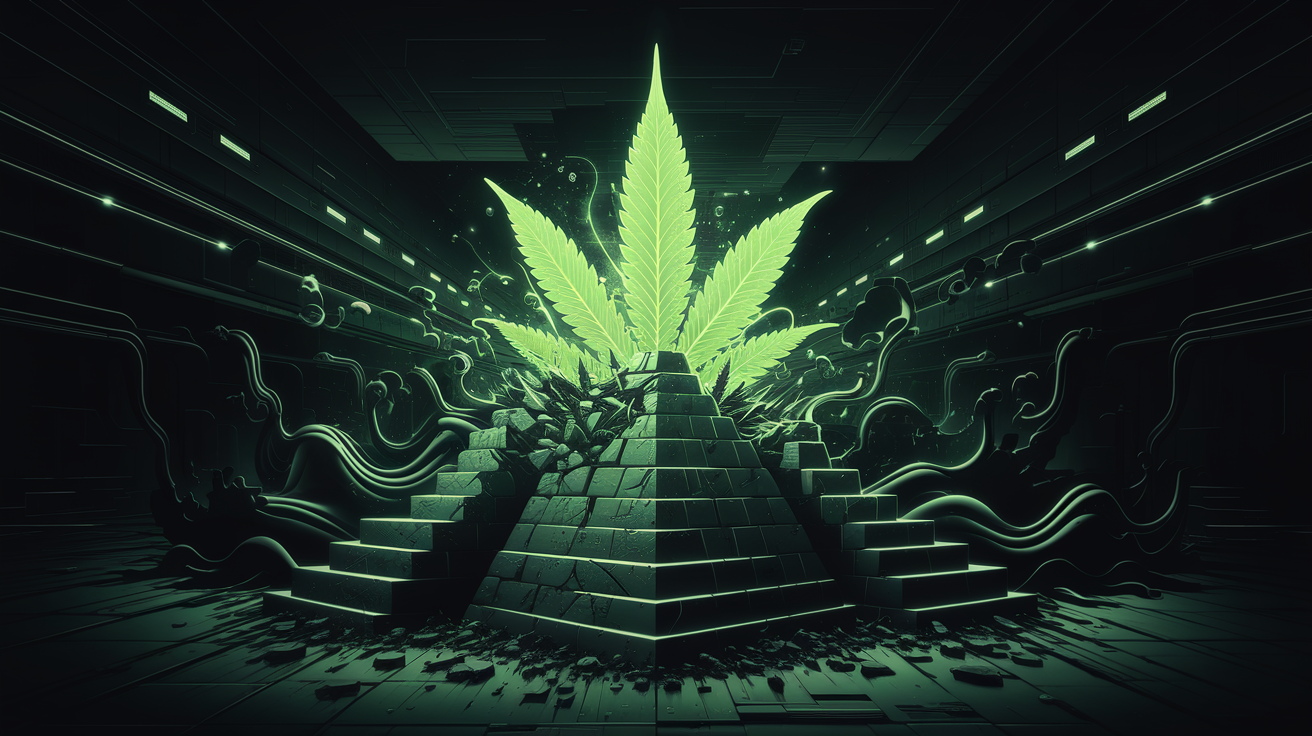
The BLPs have their pyramids. We have our networks. History shows which one wins.
Closing
Cannabis makes you harder to organize because it makes you harder to control. It dissolves the cognitive infrastructure that hierarchy depends on: fear, conformity, convergent thinking, and blind obedience. It replaces those with the cognitive tools of adaptation: creativity, skepticism, pattern recognition, and autonomous decision-making.
This isn't a weakness. This is the whole point. The plant evolved to produce this exact effect. Your endocannabinoid system evolved to receive it. And the fact that authoritarian systems have spent a century trying to suppress it should tell you everything you need to know about how effective it is.
You can't organize stoners into an army. But you don't need an army when you have a network. And you don't need a general when everyone in the network is capable of thinking for themselves.
That's not a bug. That's the upgrade.

Comments
Related Articles
Cannabis and the Adaptive Mind
Stop Trying to Convince BLPs
Cannabis Prohibition: A Case Study in Government Failure
The Extinction of Backward-Looking People
Cannabis is Not a Drug
Want More?
Subscribe to The Forward Look on YouTube to get notified when new episodes drop.
Subscribe