The 13% Scandal
Why medical schools don't teach the endocannabinoid system.
The Wizard Behind the Curtain
Inside you is the most sophisticated regulatory system in biology—the endocannabinoid system. It's the master controller of homeostasis.
The endocannabinoid system (ECS) was discovered in 1992. It's the largest receptor system in your body. It regulates virtually every physiological process—mood, appetite, pain, inflammation, memory, reproduction, sleep. And yet...
This is the 13% scandal. The most important regulatory system in human biology is taught in only 13% of medical schools. The ECS is the wizard behind the curtain—the master regulator that controls all other systems.
Here's what makes the endocannabinoid system unique: it signals backwards.
In normal neurotransmission, signals flow from the presynaptic neuron to the postsynaptic neuron—one direction. But endocannabinoids are produced by the postsynaptic neuron and travel backwards to regulate the presynaptic neuron.
This is called retrograde transmission, and it's revolutionary. It means the receiving cell can tell the sending cell to slow down, speed up, or change what it's sending.
In 2013, a five-year-old girl named Charlotte Figi was having 300 seizures per week. She had Dravet syndrome, a severe form of epilepsy. Nothing worked.
Her parents, desperate, tried a high-CBD cannabis extract. Charlotte's seizures dropped from 300 per week to 2-3 per month.
Charlotte's story changed the conversation about cannabis medicine. The strain that helped her was renamed "Charlotte's Web" in her honor.
Charlotte's case wasn't an anomaly—it was proof of what the science had been saying all along. The endocannabinoid system isn't just another biological curiosity. It's the master regulator that ties everything together, and understanding it changes how we think about health itself.
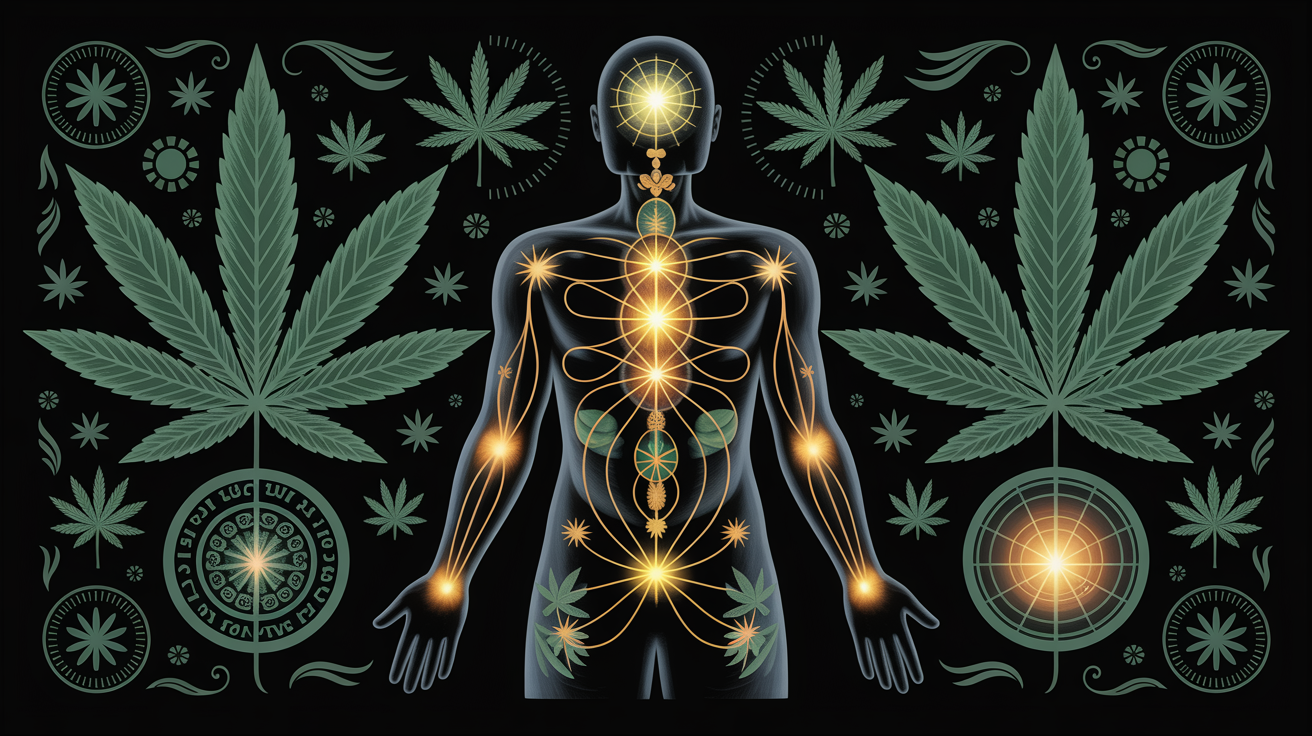
Here's what the 13% scandal obscures: cultures worldwide have been working with the endocannabinoid system for millennia—they just didn't know its name.
The Hawaiian kahunas used kava and other plant medicines to modulate states of consciousness and support healing. They understood that certain plants could shift the body's internal balance—what we now recognize as endocannabinoid modulation. The kahuna tradition of managing mana (life force energy) was, in part, a sophisticated practice of supporting what we'd call optimal ECS function.
Ayurvedic medicine classified cannabis (vijaya) as one of five sacred plants. The Atharva Veda, written around 1500 BCE, describes cannabis as one of the "five kingdoms of herbs which release us from anxiety." This wasn't mysticism—it was careful observation of plant effects on human physiology, documented across centuries.
The Rig Veda celebrates soma, a plant preparation that induced altered states and supported healing. Scholars still debate what soma was, but its described effects—euphoria, enhanced perception, healing—align with endocannabinoid modulation.
"Every major healing tradition discovered plants that do what Charlotte's Web does—modulate the endocannabinoid system. They observed what we can now measure."
This isn't about romanticizing ancient medicine or dismissing modern science. It's about recognizing that human beings have been experimenting with ECS-modulating plants for thousands of years. The knowledge was there. What we lacked was the vocabulary to explain it—and the institutional courage to study it.
The endocannabinoid system is arguably the most important biological system you've never been taught about. It regulates nearly every major function in your body—mood, appetite, sleep, pain, inflammation, memory, and immune response. It's the reason exercise makes you feel good, the reason your body can heal itself, and the reason cannabis has such profound medical effects.
Understanding the ECS changes how you think about health. You're not just a collection of parts that break down—you're a dynamic, self-regulating system constantly seeking balance. The ECS is the conductor of that orchestra, and when it's functioning well, everything works better.
This knowledge will eventually transform medicine. The question is whether we're willing to embrace it—or whether institutional inertia and political resistance will keep it hidden for another generation. The 13% scandal doesn't have to continue. The information is here. Now it's up to us to spread it.
Continue your journey through the Far From Equilibrium framework.
View All Pillars →Despite being discovered in the 1990s, the ECS is rarely taught in medical schools. This is partly due to the stigma around cannabis research and partly because it challenges the pharmaceutical model of treating symptoms rather than supporting the body's own regulatory systems.
Endocannabinoids are molecules your body produces naturally that bind to cannabinoid receptors. The two main ones are anandamide (the 'bliss molecule') and 2-AG. They regulate everything from mood and pain to inflammation and appetite.
Cannabis contains phytocannabinoids like THC and CBD that interact with the same receptors as your endocannabinoids. THC mimics anandamide, while CBD works more indirectly to enhance your body's own endocannabinoid signaling.
Not by name, but every major healing tradition discovered plants that modulate what we now call the ECS. Hawaiian kahunas used kava, Ayurvedic physicians prescribed vijaya (cannabis) as a sacred plant, and the Rig Veda celebrated soma. They observed the effects; we can now explain the mechanism. This isn't mysticism—it's millennia of careful observation.