Why Attachment Causes Suffering
The Buddha's first noble truth, explained through thermodynamics. Attachment is resistance to flow. Resistance to flow is suffering. Simple.
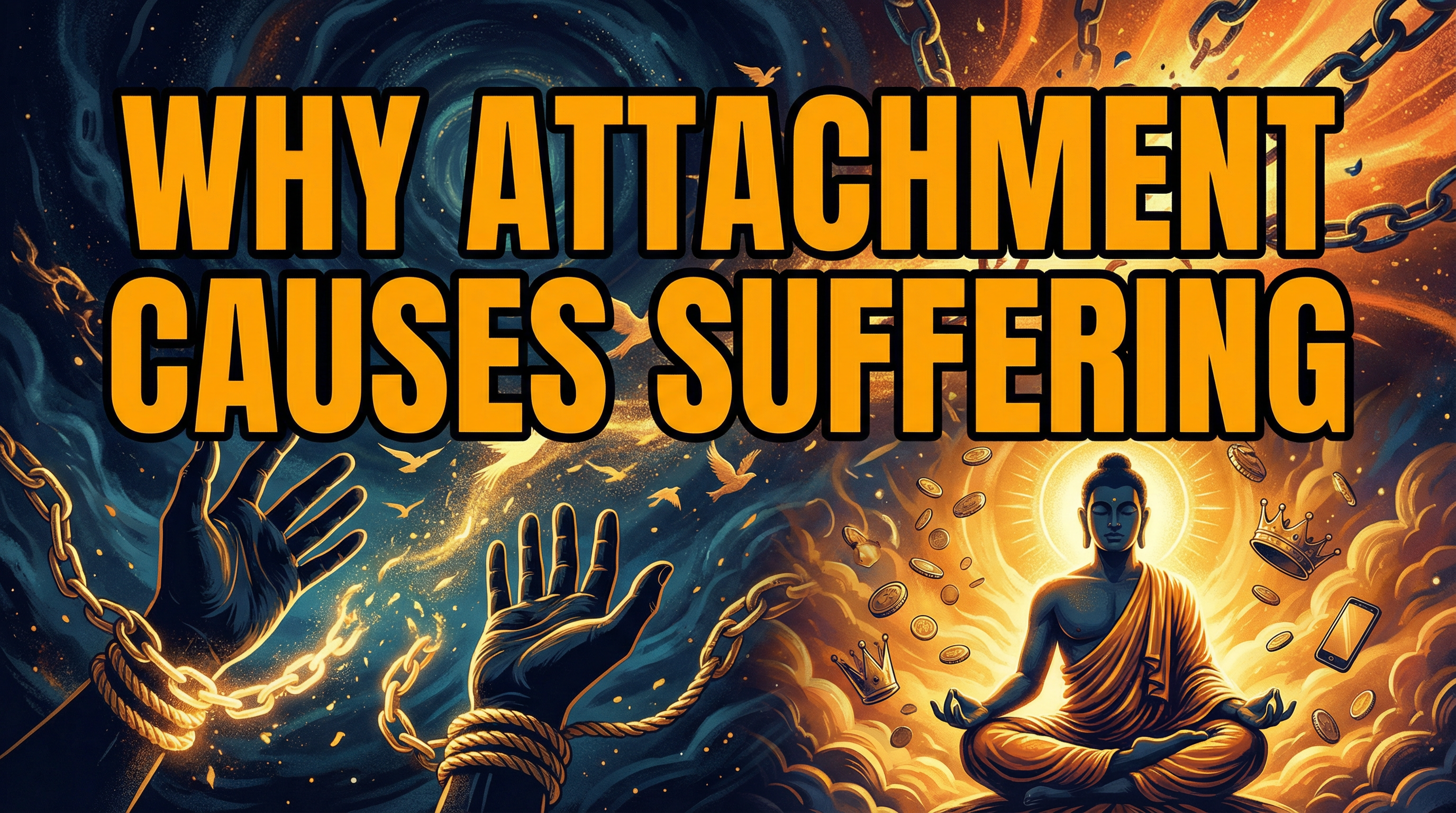

Full Article
Why Attachment Causes Suffering
The Illusion of Control
You think you’re in control, don’t you? You’ve got your five-year plan, your retirement account, your meticulously curated social media feed. You’ve built a life, a career, a family, an identity. And you cling to it. You cling to it like a drowning man to a piece of driftwood, believing that your grip, your sheer force of will, is what keeps it all together.
Bullshit.
Your attachment, your desperate, white-knuckled grip on the way you think things should be, isn’t keeping you afloat. It’s the anchor dragging you to the bottom of the ocean. You’re not suffering because life is hard. You’re suffering because you’re resisting the fundamental nature of reality. You’re suffering because you refuse to flow.
The Problem with Permanence
We’re all fed the same lie from birth: build something that lasts. A legacy. A stable career. A forever home. We crave permanence in a universe that is defined by its constant, relentless change. We try to nail down the future, to freeze moments in time, to hold onto people and possessions as if they were immutable fixtures in our personal museum.
But here’s the hard truth: nothing is permanent. The universe doesn’t give a damn about your plans. The second law of thermodynamics, the supreme law of the land, guarantees it. Entropy, the measure of disorder, always increases in an isolated system. Everything falls apart. Everything. Your body, your relationships, your achievements, your precious memories—they are all subject to the inexorable march of entropy.
Your attachment is a fight against this fundamental truth. It’s a declaration of war on the universe itself. And it’s a war you will always lose. Every time you suffer, every time you feel the sting of loss, the bitterness of disappointment, or the gnawing anxiety of uncertainty, it’s not because of the event itself. It’s because the event shattered your illusion of permanence. It’s because you were attached to an outcome that was never guaranteed.
The Application: Are You an FLP or a BLP?
So how does this apply to your life? It’s simple. You have a choice. You can be a Forward-Looking Person (FLP) or a Backward-Looking Person (BLP).
A BLP is attached. They are attached to the past, to who they used to be, to how things used to be. They resist change. They see the arrow of time as an enemy, constantly stealing from them what they hold dear. They are the ones who say, “It’s not fair,” who hold grudges, who live in a state of perpetual nostalgia or regret. They are fighting a losing battle against entropy, and their lives are filled with the suffering that comes from that resistance.
An FLP, on the other hand, embraces the flow. They understand that the past is gone, that the future is uncertain, and that the only moment that truly exists is the present. They see the arrow of time as an ally, a river carrying them forward into a sea of infinite possibility. They are adaptable, resilient, and open to the self-organization that emerges from chaos. They don’t cling; they create. They don’t resist; they adapt. They don’t suffer; they evolve.
Think about your last breakup. The pain you felt wasn’t just about losing the person. It was about losing the future you had attached to. The plans, the dreams, the identity you had built around that relationship—it all dissolved. A BLP would try to rebuild that same structure, to find someone to fit the same mold, to cling to the ghost of what was. An FLP would accept the dissolution, feel the pain without being consumed by it, and then open themselves up to the new, unexpected patterns that can emerge from the chaos of heartbreak.
The Takeaway: How to Practice Non-Attachment
Letting go isn’t a passive act of resignation. It’s an active, courageous choice to align yourself with the flow of reality. Here’s how you start:
- Acknowledge the Illusion: The first step is to see your attachments for what they are: illusions of control. Recognize the things you are clinging to—outcomes, identities, relationships, beliefs—and consciously label them as attachments.
- Embrace Impermanence: Meditate on the second law of thermodynamics. Look around you and see the evidence of entropy everywhere. Nothing is permanent. Your suffering comes from expecting it to be. Make peace with the transient nature of everything.
- Focus on the Process, Not the Outcome: In any endeavor, shift your focus from the goal to the process. Fall in love with the practice, the work, the daily act of becoming. The outcome is not in your control. The effort is. When you detach from the outcome, you free yourself to fully engage in the present moment, where life actually happens.
- Practice ‘Negative Visualization’: This is an old Stoic technique. Periodically imagine losing the things you value most. Your job, your home, your loved ones. This isn’t meant to be morbid. It’s meant to be liberating. By confronting the possibility of loss, you appreciate what you have more deeply, but you also loosen your grip on it. You rehearse for the inevitable and, in doing so, you strip it of its power to destroy you.
Closing
Attachment is the root of all suffering because it is a fundamental misunderstanding of the nature of life. You are not a static object to be preserved. You are a dynamic process of becoming. You are a pattern of flow in a universe of chaos and complexity.
Stop trying to hold onto the water in the river. Stop trying to build a dam against the arrow of time. Let go. Let the current carry you. See what new forms, what new complexities, what new life can self-organize from the raw material of your own dissolution.

Comments
Related Articles
Zen and the Art of Far-From-Equilibrium
The Three Selves: Your Internal Thermodynamic System
The Invisible Hand is Real (It's Physics)
Why Modern Medicine is Failing (And What You Can Do About It)
The Ultimate Bio-Hack
Want More?
Subscribe to The Forward Look on YouTube to get notified when new episodes drop.
Subscribe